
Strengthening Relationship Through Coherence
“Amplification is not about increasing intensity. It is about strengthening relationships“
Function Group
Amplifiers contribute clarity, coherence, and emphasis within the Visual Resonance Method.
Rather than creating something new, these materials are selected for the way they strengthen existing relationships within a composition. They help unify colour, geometry, light, and neighbouring materials, allowing the visual language of a work to communicate with greater clarity.
Within the Material Language, amplification is understood not as increasing intensity alone, but as supporting coherence.
Just as a lens brings an image into focus or a conductor helps a musical ensemble perform as one, amplifying materials contribute to the sense that a composition functions as an integrated whole.
Amplification Within the Visual Resonance Method
Every artwork created through the Visual Resonance Method is built from relationships.
Geometry provides structural order.
Colour establishes atmosphere.
Materials contribute physical character.
Symbolism offers narrative.
Amplifying materials help these individual elements work together more cohesively.
For this reason they frequently appear alongside other functional groups, supporting rather than dominating the composition.
Their role is to strengthen the conversation already taking place.
Materials Within This Function Group
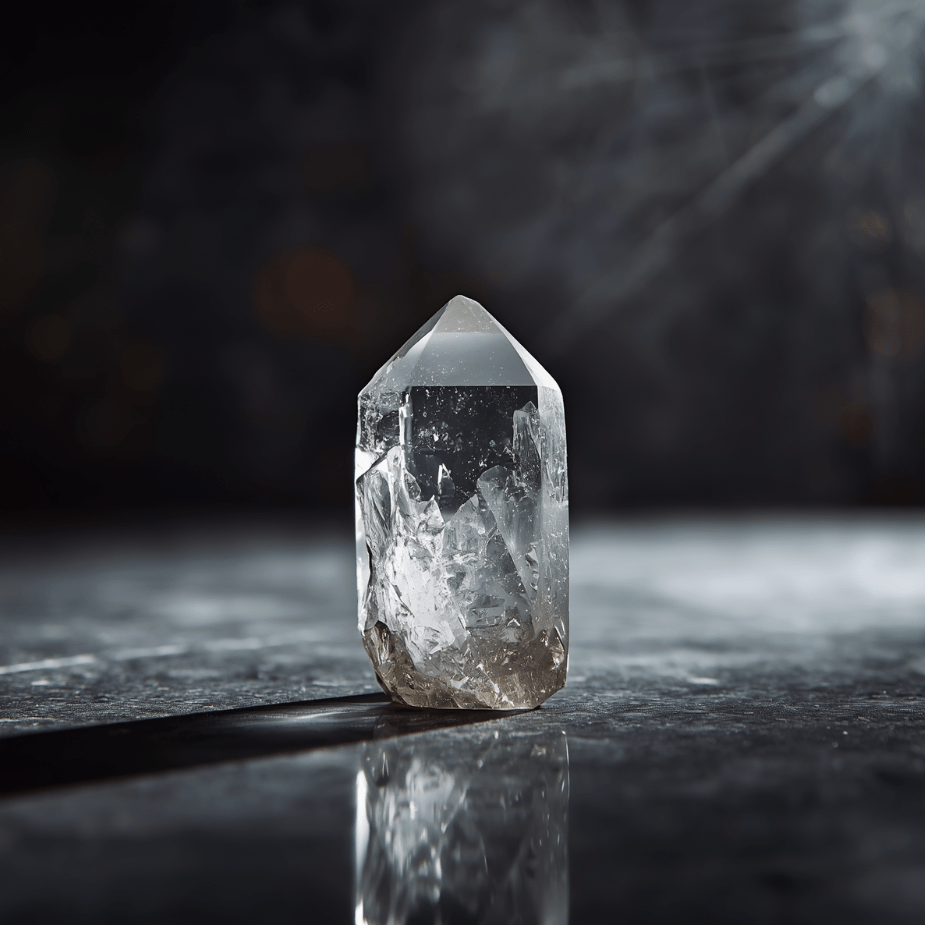
Clear Quartz
Silicon Dioxide (SiO₂)
Material Function: Amplifier · Conductor · Integrator
Geological & Scientific Context
Clear Quartz is one of the most abundant and widely studied minerals on Earth. Composed primarily of silicon dioxide (SiO₂), it forms within a hexagonal crystal system and develops over long geological timescales through the gradual cooling of silica-rich fluids.
Its exceptional optical clarity, structural stability, and hardness have made quartz valuable across both natural science and technology.
Quartz is particularly recognised for its piezoelectric properties—the ability to generate a small electrical potential when subjected to mechanical pressure. First documented in the late nineteenth century, this characteristic has led to its widespread use in watches, oscillators, microphones, sensors, medical devices, and precision electronics, where stable and predictable frequencies are essential.
Because of these measurable physical properties, quartz occupies a unique position as both a naturally occurring mineral and an important technological material.
Historical & Cultural Context
Few minerals have held as enduring a place within human history as Clear Quartz.
Ancient Greek philosophers believed exceptionally clear quartz to be permanently frozen ice, giving rise to the word krystallos, from which the modern term “crystal” is derived.
Across many cultures, quartz has been carved into ceremonial objects, protective talismans, lenses, jewellery, and devotional artefacts. Civilisations including those of Ancient Egypt, Rome, Mesoamerica, China, and Japan valued quartz for its clarity, durability, and remarkable visual qualities.
Throughout history it has frequently symbolised illumination, truth, purity, and expanded perception, appearing wherever clarity and insight were held in high regard.
Metaphysical Traditions
Within many contemporary metaphysical traditions, Clear Quartz is often regarded as an amplifying or harmonising crystal.
It has been associated with qualities such as clarity of thought, focused intention, balanced awareness, and the strengthening of other materials within a composition.
While these interpretations form part of longstanding cultural and spiritual traditions, they are not established scientific conclusions. They are best understood as symbolic frameworks through which many individuals choose to engage with the material.
Clear Quartz Within the Visual Resonance Method
Within the Visual Resonance Method, Clear Quartz frequently fulfils the role of an Amplifier and Conductor.
Rather than being selected for any single attributed property, it is valued for the way it supports relationships throughout a composition.
It often appears alongside other crystalline materials, colour harmonics, and geometric structures, contributing to the overall coherence of the work.
Its visual clarity, balanced presence, and longstanding association with focus and illumination make it a recurring material throughout the SNRGY.art collection.
Within this framework, amplification is understood not as increasing intensity alone, but as strengthening the dialogue between the elements that already exist.
Featured Within
Clear Quartz appears throughout the Visual Resonance Method, particularly within works exploring:
- Clarity & Insight
- Confidence & Courage
- Integration & Balance
- Abundance & Expansion
It is also frequently used as a supporting material across compositions where visual coherence and balanced relationships are central to the overall design.
Reflection
For thousands of years, people have been drawn to the remarkable clarity of quartz.
Whether regarded as a geological wonder, a technological material, a cultural symbol, or a source of personal meaning, its enduring presence reflects a simple human fascination with light, structure, and transparency.
Within the Visual Resonance Method, Clear Quartz continues that conversation—not as a conclusion, but as an invitation to observe how one material may contribute to the harmony of a larger whole.
| Material Profile | |
|---|---|
| Material Function | Amplifier · Conductor |
| Optical Characteristic | Transparency |
| Lustre | Vitreous (Glass-like) |
| Crystal System | Hexagonal |
| Composition | Silicon Dioxide (SiO₂) |
| Mohs Hardness | 7 |
| Colour Harmonics | CLR |
| Common Segments | Clarity & Insight · Confidence & Courage · Integration & Balance · Abundance & Expansion |
| Associated Archetypes | The Sage · The Sovereign · The Healer · The Cultivator |
| Often Paired With | Amethyst · Citrine · Pyrite · Black Tourmaline · Selenite |
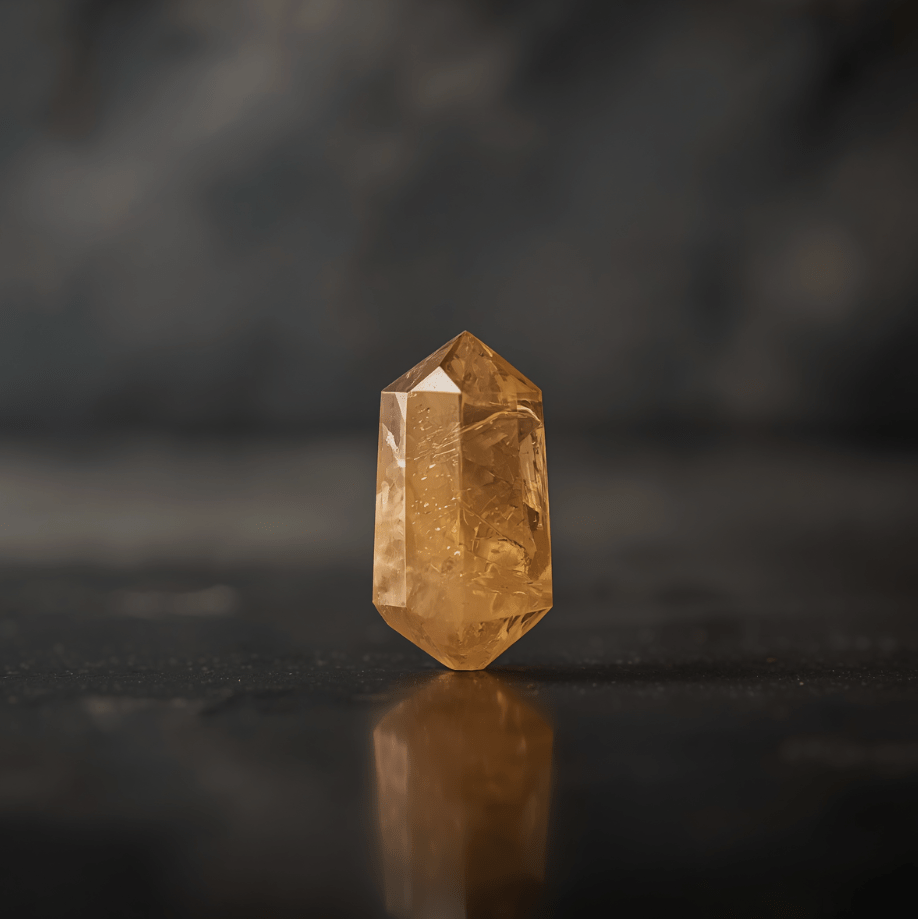
Citrine
A Variety of Quartz (Silicon Dioxide – SiO₂)
Material Function: Amplifier · Activator
Geological & Scientific Context
Citrine is a transparent to translucent variety of quartz, composed primarily of silicon dioxide (SiO₂). Its warm yellow to golden-orange colours are produced through trace amounts of iron within the crystal lattice and the geological conditions under which it formed.
Natural Citrine is relatively uncommon. Much of the Citrine available today has been created by carefully heat-treating Amethyst or Smoky Quartz, a stable process that alters the crystal’s colour while retaining its quartz structure.
Like all quartz varieties, Citrine belongs to the hexagonal crystal system and exhibits piezoelectric properties, generating a small electrical potential when subjected to mechanical pressure. These measurable characteristics contribute to quartz’s extensive use in scientific instruments, electronics, and precision technologies.
Historical & Cultural Context
For centuries, Citrine has been associated with sunlight, warmth, vitality, and prosperity.
Ancient civilisations valued golden quartz for its resemblance to the sun, often incorporating it into jewellery, ceremonial objects, and decorative works that symbolised abundance and protection.
During the nineteenth century, Citrine became particularly popular throughout Europe, appearing in Scottish jewellery and Victorian design, where its warm colour was admired for both its beauty and symbolic associations with optimism and success.
Its enduring appeal reflects humanity’s longstanding relationship with light, warmth, and the life-giving qualities of the sun.
Metaphysical Traditions
Within many contemporary metaphysical traditions, Citrine is frequently associated with confidence, creativity, optimism, motivation, and abundance.
It is often regarded as a stone that encourages purposeful action, self-belief, and a positive outlook, making it a popular companion for creative pursuits and new beginnings.
These interpretations arise from longstanding cultural and spiritual traditions rather than established scientific evidence, and are best understood as symbolic frameworks through which many people choose to engage with the material.
Citrine Within the Visual Resonance Method
Within the Visual Resonance Method, Citrine most commonly fulfils the roles of Amplifier and Activator.
Its luminous colour and visual warmth contribute energy, movement, and emphasis within a composition, particularly when paired with geometries and colour harmonics exploring confidence, emergence, and purposeful action.
Rather than acting independently, Citrine supports the overall coherence of the work by strengthening relationships between surrounding materials, geometry, and colour.
Its contribution is therefore understood as one of participation rather than dominance.
Featured Within
Citrine frequently appears throughout the SNRGY.art collection in works exploring:
- Confidence & Courage
- Activation
- Abundance & Expansion
It is often paired with Clear Quartz to support coherence, Pyrite to introduce structural emphasis, and Carnelian where movement and creative momentum are central themes.
Material Relationships
Citrine is commonly found working alongside:
Clear Quartz – supporting clarity and coherence.
Pyrite – reinforcing structure, confidence, and visual balance.
Carnelian – encouraging momentum and creative expression.
Together these materials create compositions exploring emergence, purposeful action, and sustained growth.
Reflection
Across cultures and throughout history, people have associated golden light with warmth, possibility, and renewal.
Whether appreciated for its geological beauty, historical symbolism, or role within artistic practice, Citrine continues to evoke qualities of optimism and forward movement.
Within the Visual Resonance Method, it represents more than brightness alone.
It is a reminder that meaningful growth often begins with a single spark of intention—quietly amplified through thoughtful action and carried forward with purpose.
| Material Profile | |
|---|---|
| Material Function | Amplifier · Activator |
| Optical Characteristic | Transparency |
| Lustre | Vitreous (Glass-like) |
| Crystal System | Hexagonal |
| Composition | Silicon Dioxide (SiO₂) |
| Mohs Hardness | 7 |
| Colour Harmonics | SOL · CLR |
| Common Segments | Confidence & Courage · Activation · Abundance & Expansion |
| Associated Archetypes | The Sovereign · The Creator · The Cultivator |
| Often Paired With | Clear Quartz · Pyrite · Carnelian · Selenite |
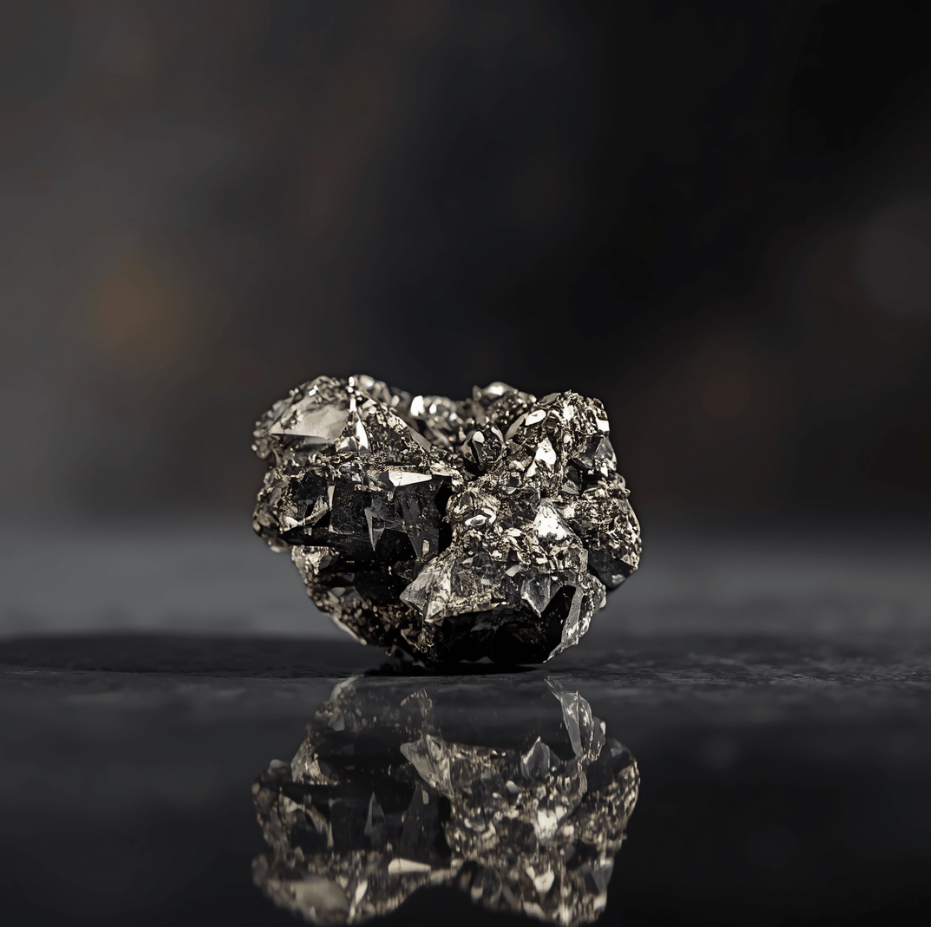
Pyrite
Iron Sulfide (FeS₂)
Material Function: Amplifier · Structural Stabiliser
Geological & Scientific Context
Pyrite is an iron sulfide mineral (FeS₂) recognised for its brilliant metallic lustre and naturally occurring cubic crystal formations. It develops within a range of geological environments, including sedimentary, metamorphic, and hydrothermal systems, often forming highly ordered crystal structures that display remarkable symmetry.
Its metallic appearance earned it the nickname “Fool’s Gold”, yet Pyrite possesses properties that make it scientifically significant in its own right.
Historically, Pyrite has been used to generate sparks for fire making and was later incorporated into early ignition systems and scientific instruments. Its highly ordered crystalline structure and conductive properties continue to make it an important mineral within geological and industrial research.
Rather than imitating gold, Pyrite offers a striking example of nature’s ability to produce order, symmetry, and structural precision.
Historical & Cultural Context
Throughout history, Pyrite has been admired for both its beauty and utility.
Ancient civilisations used polished Pyrite as decorative objects, reflective surfaces, jewellery, and ceremonial ornaments. Indigenous cultures throughout the Americas fashioned highly polished Pyrite discs into mirrors that were valued for both practical use and symbolic significance.
Across many traditions, its golden metallic appearance became associated with vitality, protection, confidence, prosperity, and resilience.
Its naturally occurring cubic forms have also inspired enduring fascination with geometry and the remarkable order found throughout the mineral world.
Metaphysical Traditions
Within contemporary metaphysical traditions, Pyrite is frequently associated with confidence, determination, resilience, protection, and abundance.
Many practitioners regard it as a symbol of disciplined action, grounded confidence, and constructive personal growth.
These interpretations arise from longstanding cultural and symbolic traditions rather than established scientific evidence and are best understood as meaningful frameworks through which many individuals choose to engage with the material.
Pyrite Within the Visual Resonance Method
Within the Visual Resonance Method, Pyrite most commonly fulfils the roles of Amplifier and Structural Stabiliser.
Its naturally ordered crystal habit, metallic character, and visual density contribute a strong sense of organisation within layered compositions.
Rather than drawing attention to itself, Pyrite frequently serves to reinforce balance, strengthen visual relationships, and provide structural emphasis alongside surrounding materials.
Within this framework, Pyrite represents integrity through organisation—supporting compositions that explore confidence, purposeful action, coherent structure, and enduring stability.
Featured Within
Pyrite appears throughout the SNRGY.art collection in works exploring:
- Confidence & Courage
- Grounding & Stability
- Protection & Boundaries
- Abundance & Expansion
It is frequently paired with Clear Quartz to strengthen compositional coherence, Citrine to support purposeful momentum, and Black Tourmaline where structure and resilience are central themes.
Material Relationships
Pyrite commonly appears alongside:
Clear Quartz – supporting clarity and coherent relationships throughout the composition.
Citrine – introducing warmth, optimism, and purposeful momentum.
Black Tourmaline – balancing structural strength with grounded stability.
Together these materials contribute compositions exploring integrity, resilience, focused intention, and thoughtful organisation.
Reflection
Nature often reveals its most remarkable patterns through structure.
Within Pyrite, precise geometry and metallic brilliance emerge through geological processes unfolding over immense spans of time.
Whether appreciated for its scientific significance, historical use, symbolic associations, or artistic qualities, Pyrite reminds us that strength is often expressed through order rather than force.
Within the Visual Resonance Method, it serves as a quiet expression of structure, integrity, and the enduring relationships that hold a composition together.
| Material Profile | |
|---|---|
| Material Function | Amplifier · Structural Stabiliser |
| Optical Behaviour | High Reflectivity |
| Lustre | Metallic |
| Crystal System | Isometric (Cubic) |
| Composition | Iron Sulfide (FeS₂) |
| Mohs Hardness | 6–6.5 |
| Colour Harmonics | SOL · EAR |
| Common Segments | Confidence & Courage · Grounding & Stability · Protection & Boundaries · Abundance & Expansion |
| Associated Archetypes | The Sovereign · The Steward · The Guardian · The Cultivator |
| Often Paired With | Clear Quartz · Citrine · Black Tourmaline · Carnelian |
Working in Relationship
Amplifying materials are rarely used alone.
Instead they are thoughtfully combined with regulators, grounding materials, harmonisers, activators, or conductors to create balanced relationships throughout a composition.
Their contribution is therefore relational rather than isolated.
The function of amplification emerges through the interaction of all materials working together.
Featured Throughout the Collection
Amplifying materials appear across many areas of the SNRGY.art collection, including Scalar Discs, Studio Monotypes, and Primary Works.
They frequently support artworks exploring themes of:
• Clarity & Insight
• Confidence & Courage
• Abundance & Expansion
while also appearing wherever visual coherence and balanced composition are desired.
Explore Related Artworks →
Related Material Functions
Amplifiers work in continual dialogue with the other Material Function Groups.
Regulators & Clarifiers
Supporting organisation, perception, and thoughtful balance.
Grounding & Shielding
Providing stability, containment, and resilient foundations.
Activators & Motivators
Encouraging movement, confidence, and purposeful expression.
Integrators & Harmonisers
Cultivating connection, cooperation, and emotional equilibrium.
Conductors & Translators
Supporting continuity and interaction between the materials within a composition.
Reflection
Amplification asks an interesting question.
Not,
“How can we make something louder?”
But rather,
“How can we help what is already present become more coherent?”
Within the Visual Resonance Method, amplification is therefore understood as an act of refinement rather than addition.
A quiet strengthening of relationships that allows the whole composition to speak with greater clarity.

