An Exploration of Geometry, Materials, and Attention
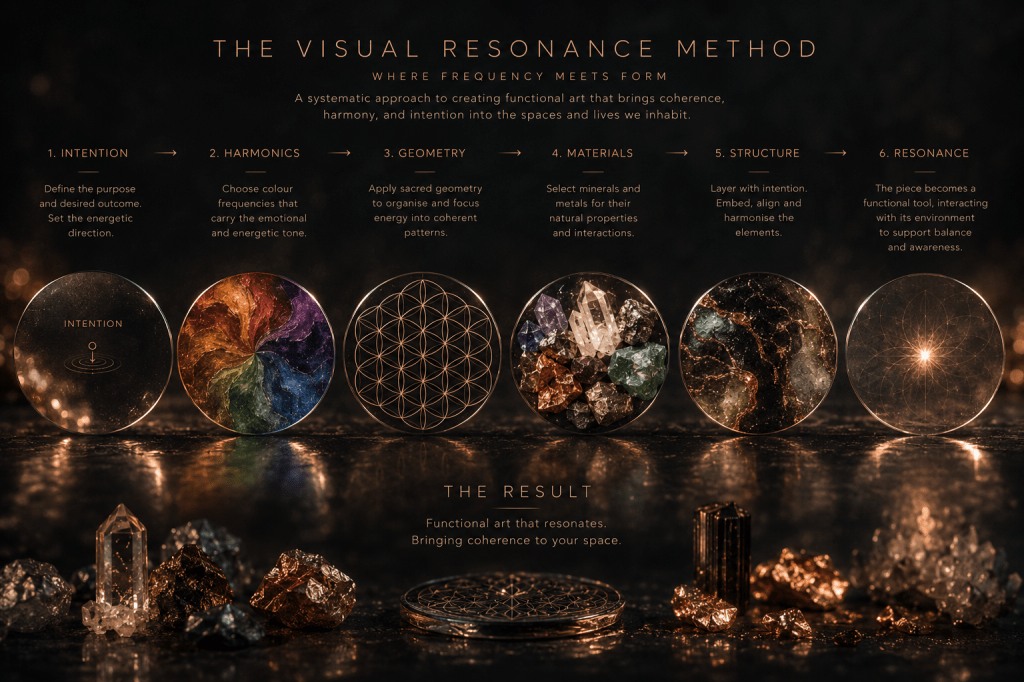
The Visual Resonance Method is the creative framework behind every SNRGY.art artwork, scalar disc, field guide, and collection.
It emerged through years of artistic experimentation, observation, and study into the relationship between form, material, perception, and environment.
Rather than beginning with a finished image, the process begins with a question:
How might the structures and materials surrounding us influence the way we think, feel, and engage with the world?
The Visual Resonance Method explores this question through layered compositions that combine geometry, colour, crystalline materials, metals, light, and symbolic form.
Each element contributes to the visual language of the work, creating pieces designed to be experienced over time rather than simply observed in passing.
A Journey of Inquiry
The Visual Resonance Method emerged through the intersection of contemporary art, sacred geometry, materials research, psychology, consciousness studies, and resonance-based philosophies. Influences include the work of Nikola Tesla, Wilhelm Reich, Walter Russell, Carl Jung, Masaru Emoto, Veda Austin, Joe Dispenza, Robert Grant and numerous historical traditions exploring the relationship between form, perception, energy, and experience.
The Visual Resonance Method did not emerge from a single theory, discipline, or tradition.
It evolved through years of artistic experimentation, observation, and curiosity about the relationships between perception, environment, and human experience.
Along the way, the journey intersected with the work of inventors, researchers, artists, and thinkers exploring resonance, consciousness, symbolism, water, energy, psychology, and natural systems. These encounters did not provide conclusions, but they expanded the questions.
From sacred geometry and archetypal psychology to studies of intention, attention, and the influence of environment, each perspective contributed a thread to an ongoing exploration.
The Visual Resonance Method does not seek to prove a particular worldview.
Instead, it offers a framework for observation.
A reminder that the spaces we create, the symbols we engage with, and the attention we bring to our experiences may shape our relationship with the world in ways both subtle and profound.
The work continues as an open inquiry—one that values curiosity over certainty, participation over prescription, and direct experience over assumption.
Geometry as Structure
Geometry is one of the oldest languages found in nature.
From the spirals of shells and galaxies to the branching of trees and river systems, recurring geometric relationships appear throughout the natural world.
Within the Visual Resonance Method, geometric forms act as structural frameworks that organise visual information and guide attention.
Recurring forms include:
• Seed of Life
• Vesica Piscis
• Fibonacci Spiral
• Cuboctahedron
• Toroidal Field Structures
• Sri Yantra-inspired harmonic forms
Each geometry is selected for its symbolic qualities, visual rhythm, and relationship to the intended theme of the work.
Colour Harmonics
Colour influences mood, perception, and attention.
Rather than being chosen purely for decoration, colour palettes are developed as harmonic systems that support the intended atmosphere of each piece.
Deep charcoals may encourage stillness and structure.
Warm ambers may evoke vitality and movement.
Indigos may support contemplation and introspection.
Soft greens may suggest restoration and renewal.
The goal is not to prescribe a specific experience, but to create visual environments that invite particular modes of attention.
Crystalline Materials
Crystals are incorporated throughout the collection as both material and symbolic elements.
Their inclusion draws upon two equally important qualities:
Physical structure.
Visual presence.
Crystalline forms represent naturally occurring order within matter, displaying remarkable geometric consistency across scales.
Within the artwork, they contribute texture, reflection, depth, and material complexity while reinforcing themes of structure, coherence, and transformation.
Metals and Conductive Elements
Copper, metallic pigments, and reflective materials are frequently incorporated throughout the work.
These elements introduce contrast, movement, and light interaction while referencing the role metals play throughout both natural and technological systems.
As lighting conditions change, reflective surfaces reveal new relationships within the composition, encouraging repeated engagement and discovery.
Light, Depth, and Observation
Many pieces reveal themselves gradually.
Details emerge from changing viewing angles.
Geometry appears and disappears.
Reflective elements shift throughout the day.
Layered surfaces encourage the eye to move slowly rather than consume the image instantly.
This process mirrors one of the central ideas of the Visual Resonance Method:
Attention changes experience.
The longer we observe something, the more information becomes available.
Observation Rather Than Belief
The Visual Resonance Method does not ask for belief.
It encourages observation.
Each work is offered as an invitation to notice.
Notice how a space feels.
Notice what captures attention.
Notice what supports focus, reflection, calm, or inspiration.
Notice what changes when intention is paired with environment.
Every viewer brings their own perspective, experiences, and interpretations.
Those observations become part of the artwork itself.
The Living Practice
The Visual Resonance Method is not a fixed system.
It is an evolving body of artistic research.
Through new materials, geometry studies, field guides, journals, and studio experiments, the framework continues to grow and adapt.
Every artwork becomes part of that exploration.
Every observation contributes to the ongoing conversation.
Because resonance is not a destination.
It is a relationship between attention, environment, and experience.
And that relationship is always unfolding.

