Facilitating Continuity Through Connection
“The strength of any system is measured by the quality of its relationships.”
Material Function
Conductors & Translators contribute continuity, communication, and relational flow within the Visual Resonance Method.
Rather than becoming dominant features within a composition, these materials support the interaction between surrounding elements, helping colour harmonics, geometry, symbolism, and neighbouring materials establish coherent relationships.
Within the Material Language, conduction is understood as the movement of relationship, while translation describes the way information is carried, interpreted, and expressed throughout a unified composition.
Like rivers connecting landscapes or mycelial networks linking entire forests beneath the soil, these materials remind us that the strength of any system often depends upon the quality of its connections.
Conduction Within the Visual Resonance Method
Every composition depends upon communication.
Geometry provides structure.
Colour harmonics establish atmosphere.
Materials contribute physical presence.
Symbolism offers meaning.
Conducting materials support the continuity between these elements, allowing them to function not as isolated components, but as an interconnected whole.
Rather than directing attention towards themselves, they encourage relationships to develop naturally, reinforcing the sense that every element contributes to something larger than its individual role.
Within the Visual Resonance Method, continuity is understood not as uniformity, but as the effortless exchange between connected parts.
Materials Within This Function Group
Selenite
A Crystalline Variety of Gypsum Distinguished by Fibrous Light Transmission
Material Function: Conductor · Translator
Geological & Scientific Context
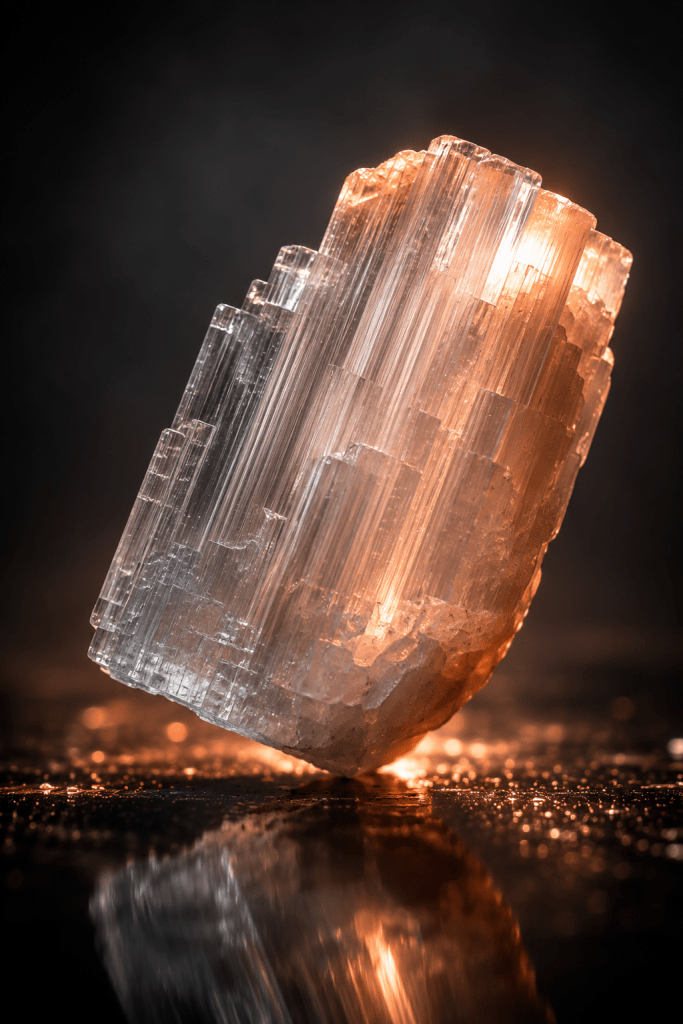
Selenite is a transparent to translucent crystalline variety of gypsum, composed primarily of hydrated calcium sulfate (CaSO₄·2H₂O). It crystallises within the monoclinic crystal system and is recognised for its exceptional clarity, delicate structure, and remarkable interaction with light.
Many ornamental specimens sold as “Selenite” are technically the fibrous variety known as Satin Spar. Its parallel crystalline fibres create a striking optical phenomenon in which light appears to travel softly through the material, producing a luminous band that shifts gently as the viewing angle changes.
With a relatively low Mohs hardness of approximately 2, Selenite is considerably softer than quartz minerals, requiring careful handling. Despite this delicacy, its internal crystalline organisation creates one of the most visually distinctive examples of natural light transmission found within the mineral world.
Its quiet luminosity has fascinated mineralogists, artists, and collectors alike, offering a remarkable demonstration of how structure influences the movement of light.
Historical & Cultural Context
Named after Selene, the ancient Greek goddess of the Moon, Selenite has long been admired for its soft luminous appearance and ethereal beauty.
Throughout history it has been carved into windows, devotional objects, architectural ornamentation, and decorative works, particularly where its ability to gently diffuse natural light could be appreciated.
Across many cultures its subtle glow became associated with clarity, reflection, and quiet contemplation.
Rather than commanding attention, Selenite has traditionally been valued for its ability to illuminate gently, revealing rather than overwhelming its surroundings.
Metaphysical Traditions
Within contemporary metaphysical traditions, Selenite is frequently associated with clarity, purification, peaceful environments, and the gentle organisation of surrounding energies.
Many practitioners regard it as a material supporting calm attention, mental clarity, and the cultivation of harmonious spaces.
These interpretations arise from longstanding symbolic and cultural traditions rather than established scientific evidence and are best understood as meaningful frameworks through which many individuals choose to engage with the material.
Selenite Within the Visual Resonance Method
Within the Visual Resonance Method, Selenite most commonly fulfils the roles of Conductor and Translator.
Its fibrous crystalline structure and remarkable interaction with light contribute continuity, communication, and quiet coherence throughout a composition.
Rather than amplifying or directing attention, Selenite supports the relationships between neighbouring materials, allowing geometry, colour harmonics, and symbolism to interact with greater clarity.
Within this framework, translation is understood as creating understanding between different elements.
Connection emerges not through dominance, but through continuity.
Like a thread weaving individual fibres into cloth, Selenite quietly supports the relationships from which coherence naturally emerges.
Featured Within
Selenite appears throughout the SNRGY.art collection in works exploring:
- Clarity & Insight
- Integration & Balance
- Conductors & Translators
It is frequently paired with Clear Quartz to strengthen coherence, Moonstone to encourage reflective awareness, and Rose Quartz where relational harmony and gentle continuity are central themes.
Material Relationships
Selenite commonly appears alongside:
Clear Quartz – supporting amplification through structural clarity and coherent relationships.
Moonstone – contributing reflection, rhythm, and evolving perception.
Rose Quartz – encouraging compassion, balance, and harmonious integration.
Together these materials establish compositions exploring continuity, communication, reflection, and relational coherence.
Reflection
The most meaningful conversations are rarely the loudest.
They are the ones in which understanding quietly passes between those willing to listen.
Selenite reminds us that clarity is not created by removing complexity.
It emerges when relationships become easier to perceive.
Within the Visual Resonance Method, Selenite represents this quiet continuity—a material that allows light, structure, and meaning to move gently through a composition, revealing the connections that were present all along.
| Material Profile | |
|---|---|
| Material Function | Conductor · Translator |
| Optical Behaviour | Fibrous Light Transmission (Chatoyancy in Satin Spar varieties) |
| Lustre | Silky to Pearly |
| Crystal System | Monoclinic |
| Composition | Hydrated Calcium Sulfate (CaSO₄·2H₂O) |
| Mohs Hardness | 2 |
| Colour Harmonics | CLR |
| Common Segments | Clarity & Insight · Integration & Balance · Conductors & Translators |
| Associated Archetypes | The Sage · The Healer |
| Often Paired With | Clear Quartz · Moonstone · Rose Quartz |
Angel Sand
A Naturally Formed Biogenic Marine Material
Material Function: Conductor · Translator
Geological & Scientific Context
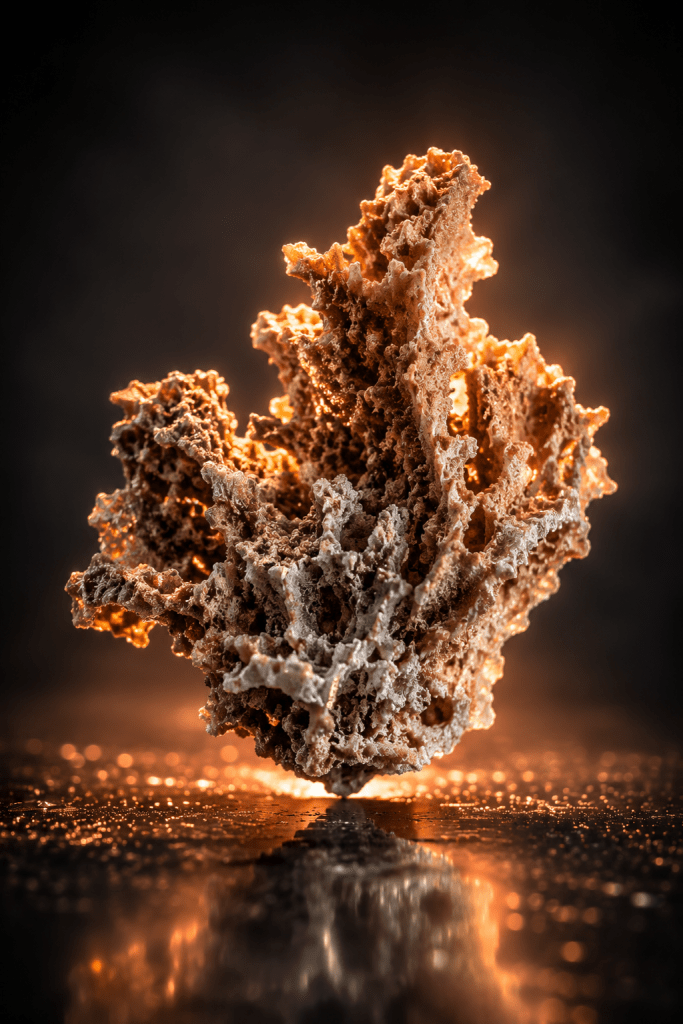
Angel Sand is a naturally occurring biogenic material composed predominantly of the fragmented skeletal remains of marine organisms, including corals, molluscs, calcareous algae, and microscopic reef-dwelling species. Over time, waves, tides, and biological processes gradually break these structures into fine carbonate sands that become part of dynamic coastal ecosystems.
Composed primarily of calcium carbonate (CaCO₃) in the form of aragonite and calcite, Angel Sand occupies a unique position between geology and biology. Unlike crystalline minerals formed solely through geological processes, it represents the continual transformation of once-living structures into new landscapes.
Each grain carries evidence of natural cycles operating across generations, quietly illustrating how biological life contributes to the formation of the Earth’s surface.
Historical & Cultural Context
Marine sands have long held symbolic significance across coastal cultures throughout the world.
Collected as keepsakes, incorporated into ritual objects, or simply appreciated for their beauty, they have often represented continuity, remembrance, and humanity’s enduring relationship with the sea.
Many Indigenous cultures understand coastlines not as fixed boundaries but as living places where land, ocean, weather, and life remain in continual conversation.
Angel Sand quietly reflects this perspective.
It is not simply sediment.
It is the visible expression of countless natural relationships unfolding across time.
Metaphysical Traditions
Within contemporary metaphysical traditions, marine sands are often associated with cleansing, transition, ancestral memory, emotional flow, and the cyclical nature of life.
Many practitioners regard them as symbolic reminders of continuity, adaptability, and the interconnectedness of natural systems.
These interpretations arise from cultural and symbolic traditions rather than established scientific evidence and are best understood as meaningful frameworks through which many individuals choose to engage with the material.
Angel Sand Within the Visual Resonance Method
Within the Visual Resonance Method, Angel Sand most commonly fulfils the roles of Conductor and Translator.
Unlike crystalline minerals that contribute through ordered lattice structures, Angel Sand contributes through relationship itself.
Every grain represents countless interactions between living organisms, geological processes, water movement, and time.
Its presence within a composition introduces themes of continuity, adaptation, and the quiet exchange between individual parts and the larger systems to which they belong.
Within this framework, translation is understood as the movement of relationship across different scales.
From organism to reef.
From reef to shoreline.
From landscape to observer.
Angel Sand quietly reminds us that every stable system is built through countless acts of connection.
Featured Within
Angel Sand appears throughout the SNRGY.art collection in works exploring:
- Conductors & Translators
- Integration & Balance
- Clarity & Insight
It is frequently paired with Selenite to support continuity, Clear Quartz to reinforce coherence, and Rose Quartz where themes of relationship and gentle integration are central to the composition.
Material Relationships
Angel Sand commonly appears alongside:
Selenite – supporting continuity, clarity, and the gentle transmission of relationships.
Clear Quartz – reinforcing coherent structure throughout layered compositions.
Rose Quartz – encouraging compassionate connection and harmonious integration.
Together these materials establish compositions exploring continuity, ecological relationship, communication, and the emergence of coherence through interconnected systems.
Reflection
A single grain of sand is easy to overlook.
Yet every shoreline is composed of countless grains brought together through time, movement, and relationship.
Angel Sand reminds us that the smallest contributions often become the foundations of something far greater.
Within the Visual Resonance Method, it represents continuity across living systems—a quiet acknowledgement that connection is not an abstract idea, but a process continuously shaping the world around us.
Every grain carries a history.
Together, they become a landscape.
| Material Profile | |
|---|---|
| Material Function | Conductor · Translator |
| Optical Behaviour | Diffuse Mineral Reflection |
| Lustre | Earthy to Dull |
| Crystal System | Biogenic Aggregate (No Single Crystal System) |
| Composition | Primarily Calcium Carbonate (CaCO₃) in Aragonite & Calcite Forms |
| Mohs Hardness | Approximately 3 |
| Colour Harmonics | EAR · CLR |
| Common Segments | Conductors & Translators · Integration & Balance |
| Associated Archetypes | The Healer · The Sage |
| Often Paired With | Selenite · Clear Quartz · Rose Quartz |
Clear Quartz
A Crystalline Bridge for Clarity, Continuity & Coherent Relationships
Material Function: Conductor · Translator (Secondary Role)
Clear Quartz Within the Visual Resonance Method
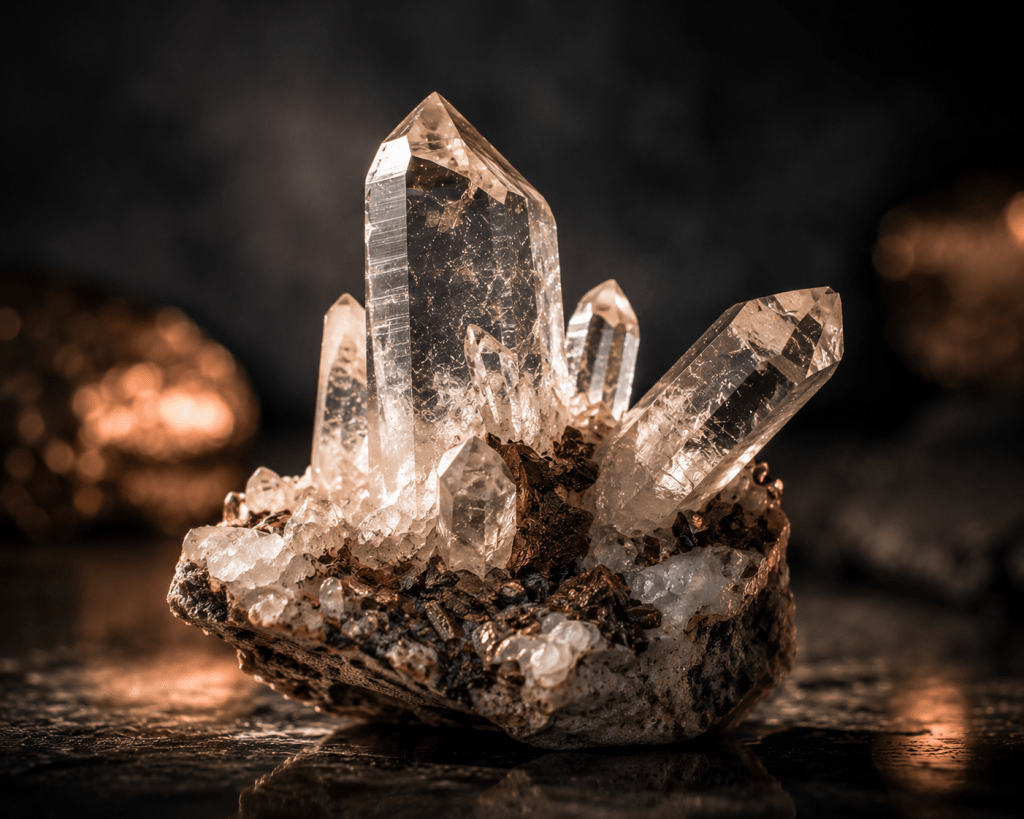
While Clear Quartz primarily functions as an Amplifier within the Material Language, it also fulfils an important secondary role as a Conductor and Translator.
Its exceptional optical clarity, ordered crystalline structure, and well-documented piezoelectric properties make it uniquely suited to supporting continuity between neighbouring materials within a composition.
Rather than introducing a dominant visual character of its own, Clear Quartz often serves as a bridge.
It strengthens relationships between colour harmonics, geometry, conductive materials, and surrounding minerals, allowing each component to contribute more coherently to the overall composition.
Within the Visual Resonance Method, conduction is understood not simply as transmission, but as continuity.
Translation is the quiet process through which individual qualities become part of a unified whole.
In this way, Clear Quartz supports not only amplification, but communication.
It helps individual materials retain their own identity while participating in something greater than themselves.
Material Relationships
As a conductor, Clear Quartz frequently appears alongside:
Selenite — supporting gentle continuity and the clear movement of relationships throughout a composition.
Angel Sand — reinforcing themes of environmental connection, natural cycles, and continuity across living systems.
Rose Quartz — encouraging relational balance while maintaining clarity between individual elements.
Black Tourmaline — bridging stable structure with coherent organisation.
Through these relationships, Clear Quartz contributes not by becoming the focus, but by quietly strengthening the dialogue between every material within the composition.
Reflection
Some materials speak with great presence.
Others create the conditions in which every voice can be heard.
Within the Visual Resonance Method, Clear Quartz reminds us that communication is not measured by volume, but by clarity.
Like clear water revealing the riverbed beneath, its greatest contribution is not what it adds, but what it allows us to perceive.
In supporting continuity between materials, it quietly demonstrates one of the central ideas of the Visual Resonance Method:
Coherence emerges when every relationship is allowed to communicate clearly.
Working in Relationship
Conductors & Translators rarely define a composition independently.
Instead, they strengthen the dialogue between every Material Function Group.
They allow amplifiers to reinforce coherence, regulators to organise perception, grounding materials to establish stable foundations, activators to encourage purposeful movement, and integrators to cultivate harmonious relationships.
Their contribution lies not in changing the identity of other materials, but in supporting the continuity that allows those identities to remain connected.
Within the Visual Resonance Method, communication is itself a form of structure.
Featured Throughout the Collection
Conductors & Translators appear throughout Scalar Discs, Studio Monotypes, and Primary Works where continuity, clarity, coherence, and relational flow are central to the work.
They are particularly associated with artworks exploring:
• Clarity & Insight
• Integration & Balance
• Abundance & Expansion
while also supporting layered compositions that seek to strengthen relationships between geometry, colour harmonics, and material presence.
Explore Related Artworks →
Related Material Functions
Conductors & Translators work in continual dialogue with every Material Function Group.
Amplifiers
Strengthening coherence and reinforcing relationships.
Regulators & Clarifiers
Supporting discernment, organisation, and balanced perception.
Grounding & Stability
Providing resilient foundations and structural integrity.
Activators & Motivators
Encouraging purposeful movement and creative emergence.
Integrators & Harmonisers
Cultivating connection, compassion, and balanced relationships.
Reflection
The most influential structures are often invisible.
Roots beneath a forest.
Rivers shaping a landscape.
The countless relationships that quietly sustain living systems.
Conductors remind us that connection is not simply the movement of information.
It is the movement of understanding.
Within the Visual Resonance Method, these materials represent the quiet pathways through which coherence develops.
They do not ask to be noticed.
They simply allow everything else to belong together.
Like the unseen threads that weave a tapestry into a single image, their contribution is measured not by prominence, but by the continuity they create.
When relationships are supported with care, the whole becomes greater than the sum of its parts.

