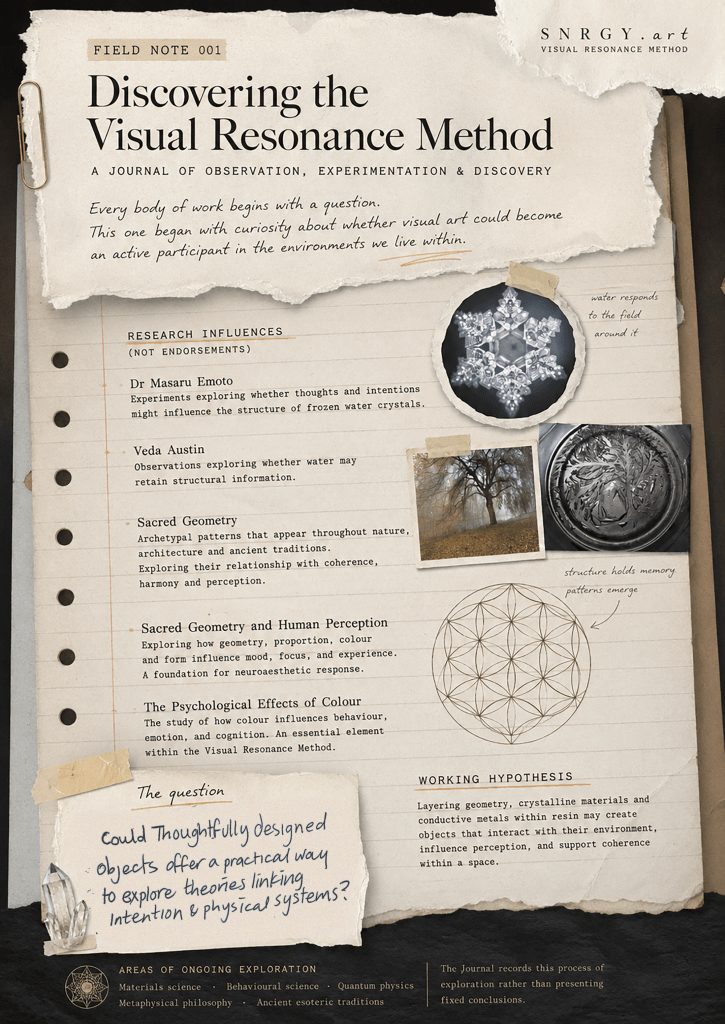
Discovering the Visual Resonance Method
Status
🟤 Initial Investigation
Research Areas
Visual Perception • Materials • Geometry • Colour • Studio Practice
Estimated Reading Time
8–10 minutes
Overview
Every body of work begins with a question.
For me, that question wasn’t “How do I make another artwork?” It was “Could visual art become an active participant in the environments we live within?”
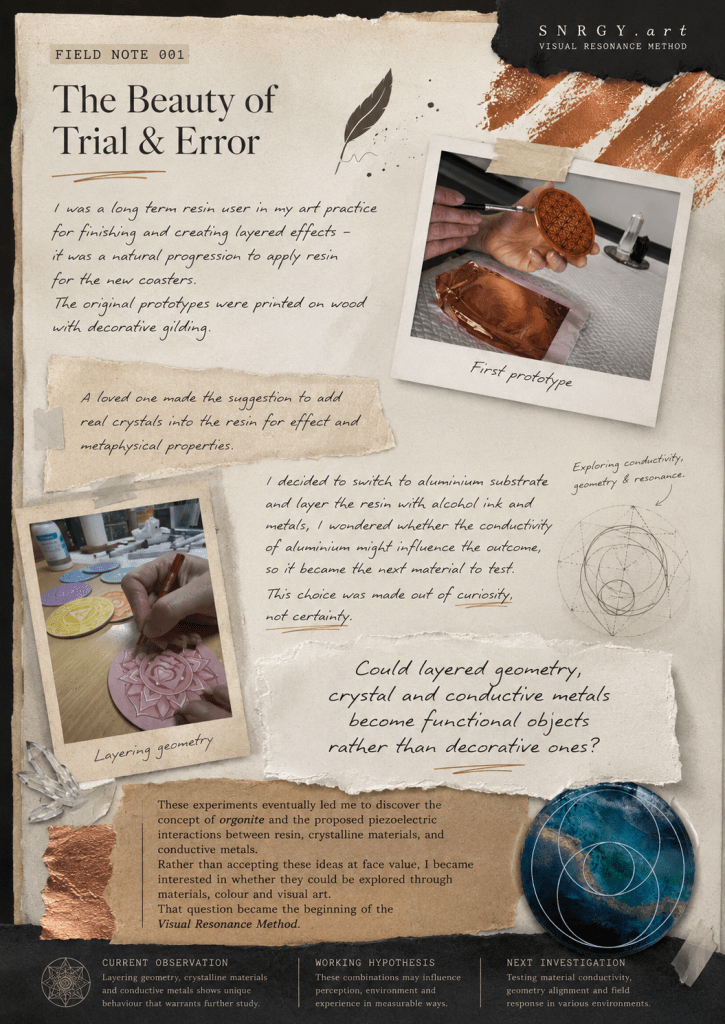
What began as a simple exploration of resin, colour and layered surfaces gradually expanded into something much larger. Small material decisions led to unexpected discoveries, introducing ideas from geometry, psychology, materials science and philosophies that consider the relationship between perception and environment.
Rather than following a predetermined theory, the process unfolded through experimentation. Some observations aligned with established scientific disciplines, while others encouraged exploration into historical traditions and contemporary ideas that remain open to discussion. Each experiment generated new questions, gradually shaping what would become the Visual Resonance Method.
This first Field Note documents the beginning of that journey.
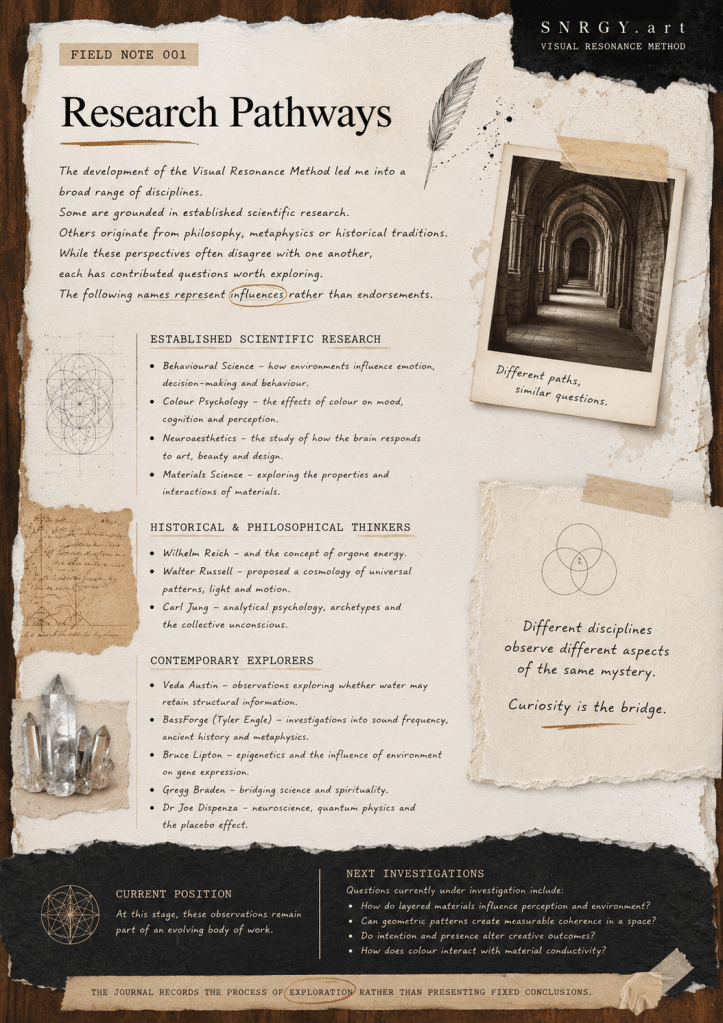
It traces the progression from an artist’s curiosity about materials to the emergence of a research practice that continues to evolve today. Alongside early experiments and visual documentation, it introduces several of the disciplines and thinkers that have influenced the direction of the work—not as definitive answers, but as research pathways that continue to inform future investigations.
The purpose of this Field Note is not to establish certainty.
It is to record where the questions began.
Inside this Field Note
Part I — Discovering the Visual Resonance Method
The early questions, influences and observations that sparked the investigation into colour, geometry and perception.
Part II — The Beauty of Trial & Error
How experimentation with materials, resin, aluminium and crystalline structures unexpectedly redirected the development of the work.
Part III — Research Influences
An introduction to the diverse scientific, philosophical and historical perspectives that continue to inform the evolving Visual Resonance Method.
Questions Explored
- Can visual environments influence the way we think, feel and interact with a space?
- Could geometry, colour and layered materials become functional rather than purely decorative?
- What role do experimentation and failure play in developing a creative methodology?
- How might ideas from different disciplines contribute to a broader understanding of visual resonance?
Current Position
At this stage, the Visual Resonance Method remains an evolving body of work.
The observations documented here represent the beginning of an ongoing investigation rather than a completed theory. Future Field Notes will continue to refine, challenge and expand these ideas as new experiments, materials and research emerge.
Looking Ahead
Next Investigation
FIELD NOTE 002
The Behaviour of Materials
Unexpected failures in resin adhesion revealed that some of the most valuable discoveries happen when experiments refuse to behave as expected.

