
Strong Foundations Through Structural Integrity
“Stability is not the absence of movement. It is the presence of strong foundations“
Material Function
Grounding & Stability materials contribute resilience, structural integrity, and compositional balance within the Visual Resonance Method.
Rather than restricting movement, these materials establish reliable foundations from which the other elements of a composition are able to interact with confidence.
Within the Material Language, grounding is understood as creating connection, while stability concerns the development of enduring structure.
Like the roots of a tree, the bedrock beneath a landscape, or the foundations of a building, these materials perform their role quietly, supporting the whole without demanding attention.
Grounding Within the Visual Resonance Method
Every composition is an arrangement of relationships.
Geometry establishes structure.
Colour harmonics shape atmosphere.
Materials contribute physical character.
Symbolism introduces meaning.
Grounding materials provide the stable framework within which these relationships can develop.
Rather than slowing a composition, they allow it to evolve with greater coherence by contributing visual weight, balance, and a sense of continuity.
Within the Visual Resonance Method, stability is therefore understood not as rigidity, but as the presence of reliable relationships that allow complexity to emerge naturally.
Materials Within This Function Group
Shungite
A Naturally Occurring Carbon-Rich Mineraloid
Material Function: Grounding · Stability
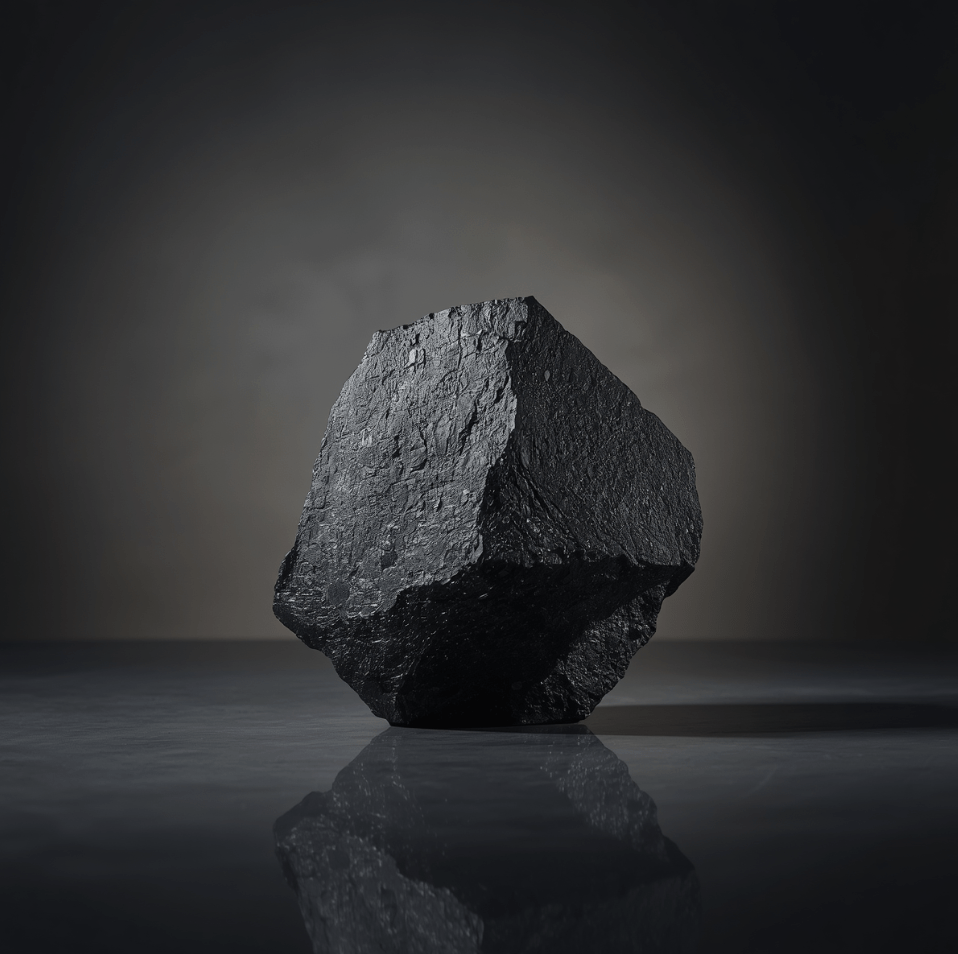
Geological & Scientific Context
Shungite is a rare, naturally occurring carbon-rich mineraloid found predominantly in the Karelia region of north-west Russia. Formed over approximately two billion years ago from ancient organic sediments, it represents one of Earth’s oldest naturally occurring carbon materials.
Unlike crystalline minerals such as Quartz or Tourmaline, Shungite does not possess a regular crystal lattice. Instead, it consists primarily of amorphous carbon with varying quantities of silicate minerals and trace elements, giving each specimen its distinctive appearance and character.
Scientific interest in Shungite increased significantly following the discovery that some varieties contain naturally occurring fullerenes—hollow carbon molecules composed of interconnected carbon atoms. Awarded the Nobel Prize in Chemistry in 1996, fullerene research has contributed to ongoing investigations into advanced materials, nanotechnology, electronics, and material science.
While only particular grades of Shungite contain measurable fullerene concentrations, the material remains scientifically significant due to its unusual carbon composition and remarkable geological history.
Historical & Cultural Context
For centuries, Shungite has been valued throughout the Karelia region for its practical use and distinctive appearance.
Historical records describe its use in water filtration, architectural applications, decorative objects, and local craftsmanship, while Russian folklore often associated the material with purification, resilience, and protection.
During the reign of Peter the Great, Shungite gained wider recognition when mineral-rich springs flowing through Shungite deposits were established as one of Russia’s earliest therapeutic spas. Although the beneficial properties of these waters continue to be studied, this period contributed significantly to the material’s enduring cultural reputation.
Today, Shungite occupies an unusual position where geological significance, cultural history, and contemporary artistic practice intersect.
Metaphysical Traditions
Within contemporary metaphysical traditions, Shungite is frequently associated with grounding, protection, energetic containment, and environmental balance.
Many practitioners regard it as a material supporting resilience, personal boundaries, and the creation of calm, ordered environments.
These interpretations arise from cultural and symbolic traditions rather than established scientific evidence and are best understood as meaningful frameworks through which many individuals choose to engage with the material.
Shungite Within the Visual Resonance Method
Within the Visual Resonance Method, Shungite most commonly fulfils the roles of Grounding and Stability.
Its rich carbon composition, visual density, and naturally matte surface contribute qualities of compositional weight, containment, and structural balance.
Rather than acting as an isolated focal point, Shungite provides a stable foundation from which surrounding materials, colour harmonics, and geometric structures are able to establish stronger visual relationships.
Within this framework, grounding is understood as creating dependable structure.
Stability emerges through thoughtful relationships between every element within the composition.
Featured Within
Shungite appears throughout the SNRGY.art collection in works exploring:
- Grounding & Stability
- Protection & Boundaries
- Confidence & Courage
It is frequently paired with Black Tourmaline to establish resilient structural foundations, Clear Quartz to support compositional coherence, and Pyrite where integrity and organised relationships are central themes.
Material Relationships
Shungite commonly appears alongside:
Black Tourmaline – contributing structural definition and resilient stability.
Clear Quartz – supporting clarity and coherent relationships throughout the composition.
Pyrite – reinforcing structure, organisation, and enduring balance.
Together these materials establish compositions exploring containment, resilience, thoughtful structure, and grounded confidence.
Reflection
Among Earth’s oldest carbon materials, Shungite reminds us that enduring strength is often shaped across immense spans of time.
Its quiet presence is neither decorative nor dramatic.
Instead, it contributes a sense of permanence—a visual reminder that lasting foundations are built patiently, layer by layer, through relationships capable of supporting everything that follows.
Within the Visual Resonance Method, Shungite represents the value of stability.
Not as resistance to change, but as the strength that allows meaningful change to unfold with confidence.
| Material Profile | |
|---|---|
| Material Function | Grounding · Stability |
| Optical Behaviour | Opaque Carbon Structure |
| Lustre | Sub-metallic to Dull |
| Crystal System | Amorphous Mineraloid |
| Composition | Predominantly Carbon with Silicate Minerals & Trace Elements |
| Mohs Hardness | 3.5–4 |
| Colour Harmonics | EAR · AXS |
| Common Segments | Grounding & Stability · Protection & Boundaries · Confidence & Courage |
| Associated Archetypes | The Steward · The Guardian · The Sovereign |
| Often Paired With | Black Tourmaline · Clear Quartz · Pyrite |
Black Tourmaline
A Complex Borosilicate Mineral (Schorl)
Material Function: Grounding · Stability
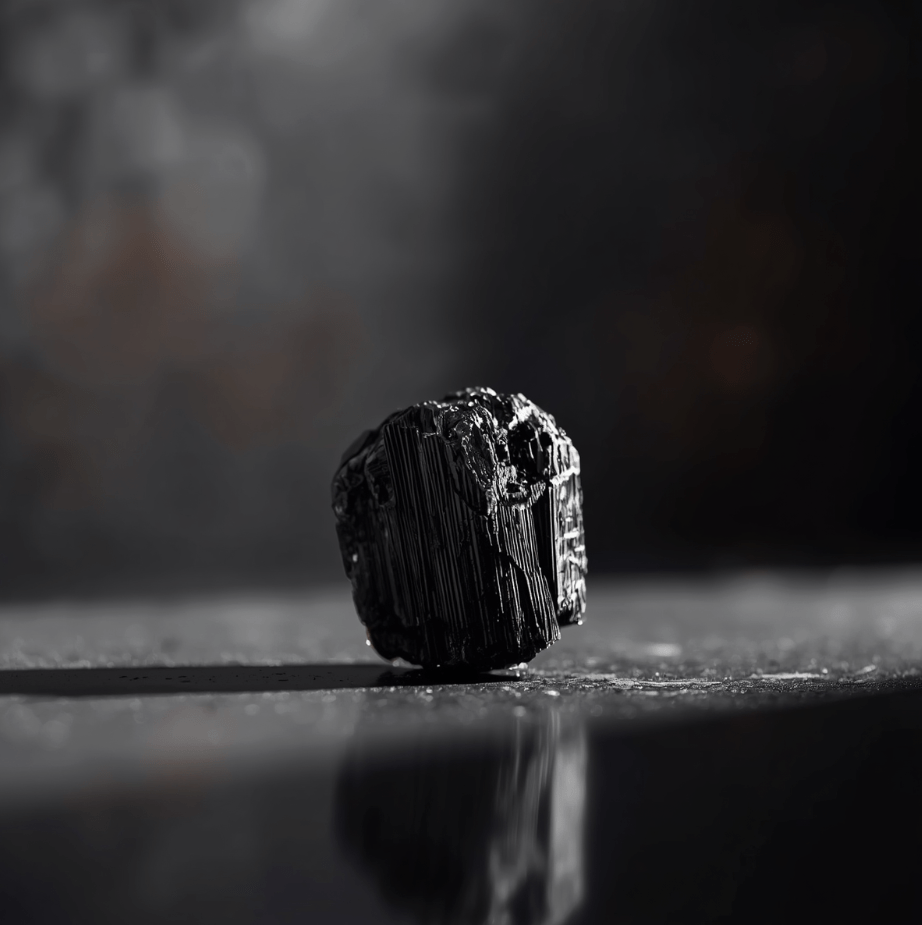
Geological & Scientific Context
Black Tourmaline, known mineralogically as Schorl, is the most abundant member of the tourmaline group. It is a complex borosilicate mineral containing varying proportions of iron, aluminium, sodium, magnesium, and other trace elements, giving rise to its exceptional structural diversity.
Tourmaline crystallises within the trigonal crystal system, commonly forming elongated prismatic crystals distinguished by deep longitudinal striations. These naturally ordered crystal habits have fascinated mineralogists for centuries and contribute significantly to the stone’s distinctive appearance.
Black Tourmaline is particularly recognised for exhibiting both piezoelectric and pyroelectric properties. Mechanical pressure or changes in temperature can generate measurable electrical charges across the crystal, characteristics that continue to be studied within mineral physics and materials science.
These measurable behaviours have established Tourmaline as one of the more scientifically intriguing minerals within the broader silicate family.
Historical & Cultural Context
Black Tourmaline has been valued throughout many cultures for both its practical qualities and striking appearance.
Historical records suggest its use as a decorative stone, carving material, and ornamental mineral across parts of Africa, Asia, and Europe, while nineteenth-century scientific investigations into its electrical behaviour helped establish Tourmaline as an important subject within early crystallography.
Within many cultural traditions, its dark colour and robust crystal structure became associated with resilience, stability, and the establishment of healthy boundaries.
Its naturally elongated crystal habit has long inspired comparisons with growth, direction, and organised structure.
Metaphysical Traditions
Within contemporary metaphysical traditions, Black Tourmaline is frequently associated with grounding, protection, resilience, and energetic boundaries.
Many practitioners regard it as a material supporting emotional stability, composure, and the creation of environments that encourage calm attention and thoughtful presence.
These interpretations arise from longstanding symbolic and cultural traditions rather than established scientific evidence and are best understood as meaningful frameworks through which many individuals choose to engage with the material.
Black Tourmaline Within the Visual Resonance Method
Within the Visual Resonance Method, Black Tourmaline most commonly fulfils the roles of Grounding and Stability.
Its naturally ordered crystal habit, visual density, and linear structure contribute qualities of definition, organisation, and compositional integrity.
Rather than introducing visual weight alone, Black Tourmaline establishes direction.
Its elongated crystalline form reinforces relationships between geometry, colour harmonics, and neighbouring materials, helping compositions develop a stronger sense of organisation and structural continuity.
Within this framework, stability is understood not as stillness, but as the quiet confidence that emerges when every element is supported by clear and well-defined relationships.
Featured Within
Black Tourmaline appears throughout the SNRGY.art collection in works exploring:
- Grounding & Stability
- Protection & Boundaries
- Confidence & Courage
It is frequently paired with Shungite to establish resilient foundations, Clear Quartz to strengthen compositional coherence, and Pyrite where structural organisation and balanced relationships are central to the work.
Material Relationships
Black Tourmaline commonly appears alongside:
Shungite – contributing compositional weight, containment, and enduring foundations.
Clear Quartz – supporting clarity and coherent relationships throughout the composition.
Pyrite – reinforcing structure, integrity, and balanced organisation.
Together these materials establish compositions exploring resilience, thoughtful boundaries, structural confidence, and grounded presence.
Reflection
A strong structure does not impose order.
It reveals it.
Within the natural architecture of Black Tourmaline, countless layers of mineral growth align over geological time to create remarkable strength through organisation rather than force.
Within the Visual Resonance Method, Black Tourmaline represents this principle of quiet structure.
It reminds us that resilience is often built through well-established relationships, where every element supports the whole with clarity, purpose, and integrity.
| Material Profile | |
|---|---|
| Material Function | Grounding · Stability |
| Optical Behaviour | Opaque with Longitudinal Striations |
| Lustre | Vitreous |
| Crystal System | Trigonal |
| Composition | Complex Sodium Iron Aluminium Borosilicate |
| Mohs Hardness | 7–7.5 |
| Colour Harmonics | EAR · AXS |
| Common Segments | Grounding & Stability · Protection & Boundaries · Confidence & Courage |
| Associated Archetypes | The Steward · The Guardian · The Sovereign |
| Often Paired With | Shungite · Clear Quartz · Pyrite |
Hematite
An Iron Oxide Mineral (Fe₂O₃)
Material Function: Grounding · Stability
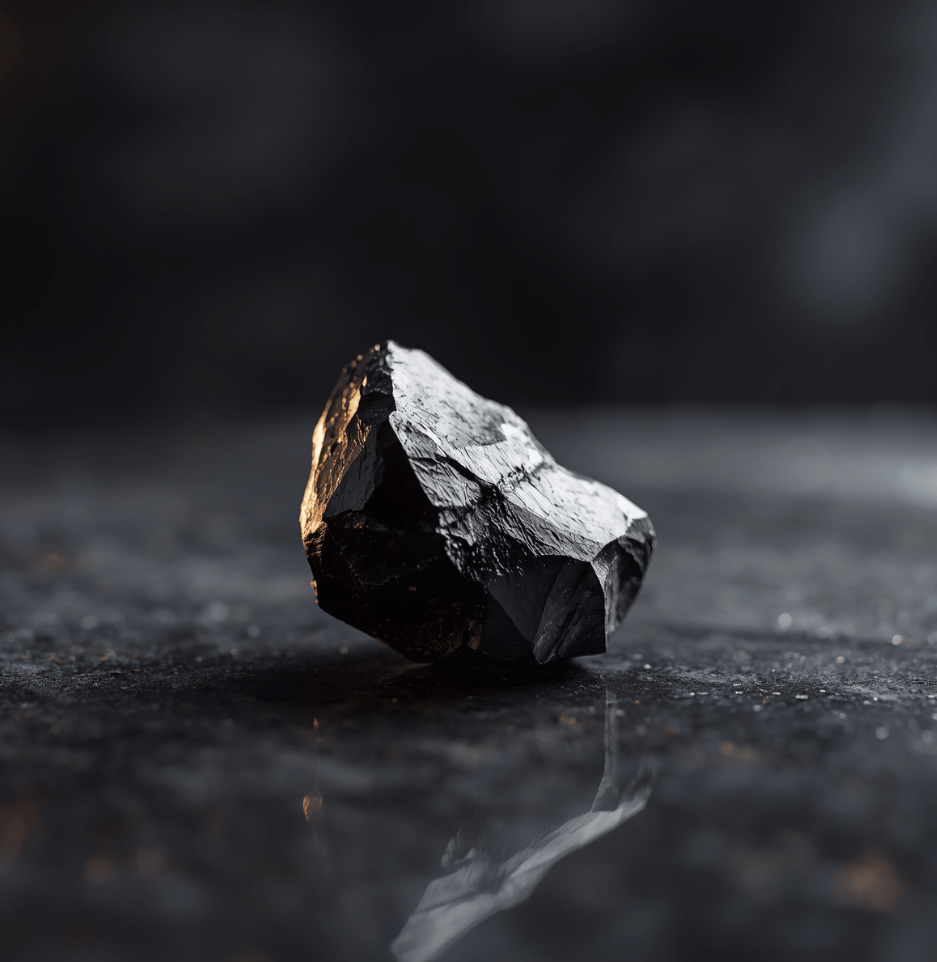
Geological & Scientific Context
Hematite is one of the most abundant iron oxide minerals on Earth, composed primarily of iron and oxygen (Fe₂O₃). It crystallises within the trigonal crystal system and occurs in a remarkable variety of forms, from metallic crystalline masses to earthy red ochres used as natural pigments.
Despite often appearing metallic silver or charcoal grey, Hematite produces a distinctive deep red streak when drawn across unglazed porcelain—a defining characteristic used by mineralogists for identification.
Its exceptionally high iron content makes Hematite one of the world’s most important iron ores, forming the foundation of modern steel production and countless engineering applications.
Dense, durable, and remarkably stable, Hematite represents one of nature’s most enduring structural materials.
Historical & Cultural Context
Few minerals have accompanied humanity for as long as Hematite.
Archaeological evidence shows its use dating back hundreds of thousands of years, where finely ground Hematite was processed into red ochre pigments for cave paintings, ceremonial body decoration, burial rituals, and artistic expression across many cultures.
Ancient Egyptians, Greeks, Romans, and numerous Indigenous cultures valued Hematite for both practical and symbolic purposes, incorporating it into jewellery, seals, carvings, tools, and decorative objects.
Throughout history, its distinctive colour, exceptional density, and connection to iron have linked Hematite with endurance, craftsmanship, resilience, and the enduring relationship between humanity and the Earth.
Metaphysical Traditions
Within contemporary metaphysical traditions, Hematite is frequently associated with grounding, balance, resilience, confidence, and centred awareness.
Many practitioners regard it as a material supporting composure, stability, and the ability to remain present during periods of change.
These interpretations arise from longstanding symbolic and cultural traditions rather than established scientific evidence and are best understood as meaningful frameworks through which many individuals choose to engage with the material.
Hematite Within the Visual Resonance Method
Within the Visual Resonance Method, Hematite most commonly fulfils the roles of Grounding and Stability.
Its exceptional density, metallic character, and visual weight contribute balance, compositional anchoring, and structural integrity within layered works.
Rather than introducing visual dominance, Hematite provides equilibrium.
Its physical presence encourages a composition to feel settled, allowing surrounding materials, geometry, and colour harmonics to establish confident and balanced relationships.
Within this framework, stability is understood as the quiet strength that emerges when every element is appropriately supported.
Featured Within
Hematite currently serves as part of the Material Language reference library and is not presently featured within the SNRGY.art collection.
Its inclusion reflects the continuing evolution of the Visual Resonance Method and acknowledges materials that may contribute to future explorations.
Material Relationships
Hematite naturally complements:
Black Tourmaline – reinforcing resilient structure and compositional definition.
Shungite – contributing visual grounding and enduring stability.
Pyrite – balancing structural organisation with metallic contrast.
Together these materials create compositions exploring resilience, balance, compositional integrity, and thoughtful structural relationships.
Reflection
Some materials command attention through brilliance.
Others through colour.
Hematite offers something quieter.
Its strength is felt through presence.
Its remarkable density reminds us that stability is not created by resisting movement, but by developing foundations capable of supporting it.
Within the Visual Resonance Method, Hematite represents this quiet equilibrium.
A reminder that lasting strength often reveals itself not through force, but through balance.
| Material Profile | |
|---|---|
| Material Function | Grounding · Stability |
| Optical Behaviour | Opaque Metallic Surface |
| Lustre | Metallic to Sub-metallic |
| Crystal System | Trigonal |
| Composition | Iron Oxide (Fe₂O₃) |
| Mohs Hardness | 5.5–6.5 |
| Colour Harmonics | EAR · SOL |
| Common Segments | Grounding & Stability · Protection & Boundaries · Confidence & Courage |
| Associated Archetypes | The Steward · The Guardian · The Sovereign |
| Often Paired With | Black Tourmaline · Shungite · Pyrite |
Working in Relationship
Grounding & Stability materials rarely define a composition on their own.
Instead, they establish the conditions in which amplifiers, regulators, activators, harmonisers, and conductors are able to perform their own roles more effectively.
Their contribution is therefore relational rather than dominant.
They provide the structural framework upon which the broader Material Language is able to develop.
Featured Throughout the Collection
Grounding & Stability materials appear throughout Scalar Discs, Studio Monotypes, and Primary Works where resilience, compositional integrity, and thoughtful structure are central to the work.
They are particularly associated with artworks exploring:
• Grounding & Stability
• Protection & Boundaries
• Confidence & Courage
while also supporting works requiring visual balance and strong foundational relationships.
Explore Related Artworks →
Related Material Functions
Grounding & Stability works in continual dialogue with the other Material Function Groups.
Amplifiers
Strengthening coherence and reinforcing relationships throughout a composition.
Regulators & Clarifiers
Supporting organisation, discernment, and balanced perception.
Activators & Motivators
Encouraging momentum, purposeful action, and creative emergence.
Integrators & Harmonisers
Cultivating connection, cooperation, and balanced relationships.
Conductors & Translators
Supporting continuity and interaction between the materials within layered compositions.
Reflection
The strongest foundations are often the least visible.
They do not seek attention.
They create the conditions in which everything else can flourish.
Within the Visual Resonance Method, grounding is not understood as remaining still, nor is stability the absence of change.
Together they describe the quiet strength of well-established relationships—the kind that allow growth, exploration, and transformation to unfold with confidence.
Like nature itself, enduring stability is not created through rigidity, but through resilient structures capable of adapting while remaining deeply connected to their foundations.

