
Cultivating Coherence Through Meaningful Relationships
“Harmony is not created through sameness. It emerges through relationships that honour difference while remaining connected“
Material Function
Integrators & Harmonisers contribute connection, balance, and relational coherence within the Visual Resonance Method.
Rather than strengthening individual elements in isolation, these materials support the way colours, geometries, symbols, and neighbouring materials interact as a unified composition. They encourage cooperation over dominance and continuity over contrast.
Within the Material Language, integration is understood as bringing diverse elements into meaningful relationship, while harmony describes the balanced interactions that naturally emerge from those relationships.
Like an ecosystem whose resilience depends upon the interdependence of every living part, these materials remind us that lasting balance is created through connection rather than uniformity.
Integration Within the Visual Resonance Method
Every composition is more than the sum of its individual materials.
Geometry establishes structure.
Colour harmonics shape atmosphere.
Materials contribute physical presence.
Symbolism introduces meaning.
Integration occurs where these individual qualities begin working together as a coherent whole.
Integrating materials help soften unnecessary contrast while strengthening the relationships that allow every component to contribute its own character without losing its individuality.
Within the Visual Resonance Method, harmony is therefore understood not as sameness, but as the balanced coexistence of complementary differences.
Materials Within This Function Group
Rose Quartz
A Pink Variety of Crystalline Quartz (Silicon Dioxide – SiO₂)
Material Function: Integrator · Harmoniser
Geological & Scientific Context
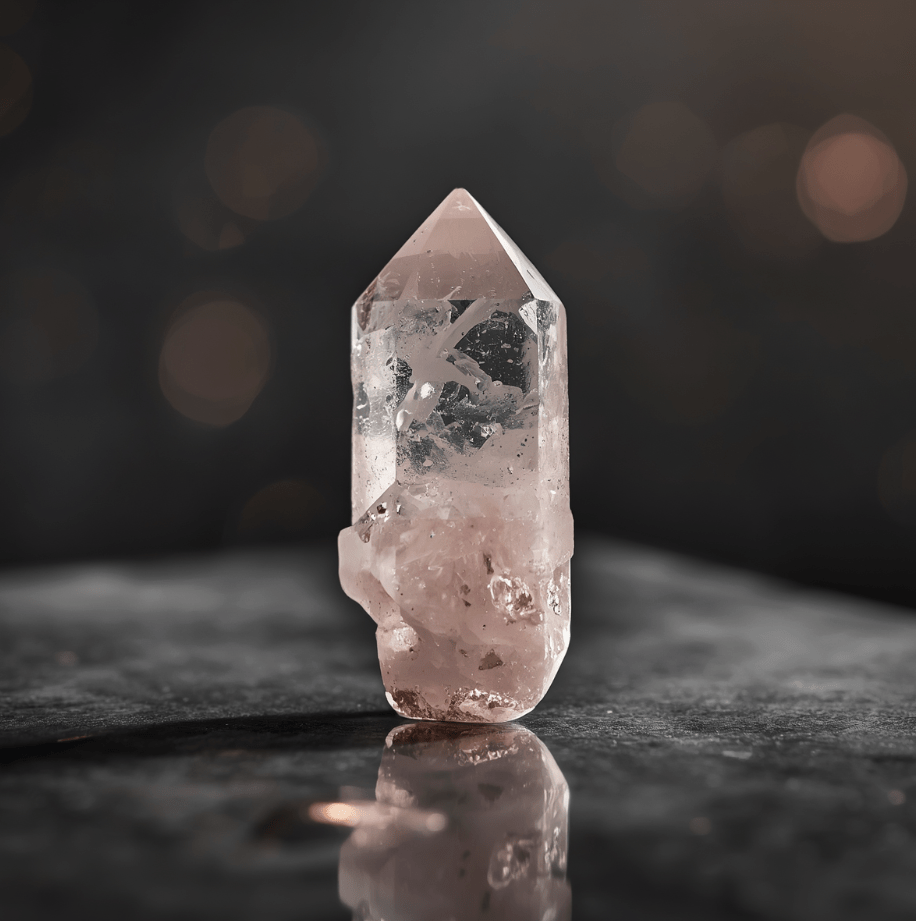
Rose Quartz is a pink variety of crystalline quartz composed primarily of silicon dioxide (SiO₂). Its characteristic colour is now understood to result from microscopic fibrous inclusions of the mineral dumortierite dispersed throughout the quartz during its formation, although trace amounts of titanium, iron, and manganese may also contribute in some specimens.
Unlike the exceptional transparency of Clear Quartz, Rose Quartz is typically translucent, allowing light to diffuse softly through the material and create its distinctive gentle appearance.
With a Mohs hardness of approximately 7, Rose Quartz combines durability with quiet visual elegance, making it one of the world’s most enduring ornamental minerals.
Its subtle colour, gentle translucency, and soft interaction with light have made it a favourite of artists, jewellers, and collectors for thousands of years.
Historical & Cultural Context
Rose Quartz has been treasured across many cultures as a material representing compassion, harmony, and enduring human connection.
Ancient Egyptian, Greek, and Roman civilisations incorporated Rose Quartz into jewellery, ceremonial objects, decorative carvings, and personal adornments, often associating its gentle colour with renewal, affection, and emotional wellbeing.
Throughout Asia and the Middle East it appeared within artistic traditions celebrating beauty, balance, and peaceful relationships.
Its enduring popularity reflects not simply its appearance, but its remarkable ability to evoke calmness, gentleness, and quiet presence.
Across cultures, Rose Quartz has consistently represented the value of kindness, openness, and meaningful connection.
Metaphysical Traditions
Within contemporary metaphysical traditions, Rose Quartz is commonly associated with compassion, emotional healing, empathy, self-acceptance, and harmonious relationships.
Many practitioners regard it as a material encouraging openness, forgiveness, emotional resilience, and the cultivation of balanced human connection.
These interpretations arise from longstanding symbolic and cultural traditions rather than established scientific evidence and are best understood as meaningful frameworks through which many individuals choose to engage with the material.
Rose Quartz Within the Visual Resonance Method
Within the Visual Resonance Method, Rose Quartz most commonly fulfils the roles of Integrator and Harmoniser.
Its gentle translucency and warm colour harmonics contribute softness, continuity, and relational balance throughout a composition.
Rather than becoming the focal point itself, Rose Quartz strengthens the relationships between neighbouring materials, encouraging compositions that feel cohesive, welcoming, and quietly restorative.
Within this framework, harmony is understood not as the absence of difference, but as the ability for diverse elements to coexist in balanced relationship.
Rose Quartz reminds us that the strongest compositions are often those in which every element supports the whole without diminishing its own identity.
Featured Within
Rose Quartz appears throughout the SNRGY.art collection in works exploring:
- Integration & Balance
- Abundance & Expansion
- Clarity & Insight
It is frequently paired with Green Aventurine to support balanced growth, Moonstone to encourage thoughtful reflection, and Clear Quartz to strengthen compositional coherence.
Material Relationships
Rose Quartz commonly appears alongside:
Green Aventurine – encouraging balanced growth, renewal, and adaptive resilience.
Moonstone – contributing gentle reflection, rhythm, and evolving awareness.
Clear Quartz – strengthening clarity and coherent relationships throughout the composition.
Together these materials establish compositions exploring compassion, connection, balance, and meaningful integration.
Reflection
The strongest connections are rarely those that demand attention.
They are the quiet relationships that allow every part to belong.
Rose Quartz reminds us that harmony is not created by removing difference.
It is created by allowing difference to exist with kindness, respect, and balance.
Within the Visual Resonance Method, Rose Quartz represents compassionate integration.
A quiet invitation to recognise that lasting coherence is cultivated not through perfection, but through relationships that allow every element to become more fully itself.
| Material Profile | |
|---|---|
| Material Function | Integrator · Harmoniser |
| Optical Behaviour | Translucency |
| Lustre | Vitreous |
| Crystal System | Trigonal (Quartz) |
| Composition | Silicon Dioxide (SiO₂) with Microscopic Fibrous Inclusions |
| Mohs Hardness | 7 |
| Colour Harmonics | HRT |
| Common Segments | Integration & Balance · Abundance & Expansion · Clarity & Insight |
| Associated Archetypes | The Healer · The Cultivator |
| Often Paired With | Green Aventurine · Moonstone · Clear Quartz |
Green Aventurine
A Quartz Variety Distinguished by Natural Aventurescence
Material Function: Integrator · Harmoniser
Geological & Scientific Context
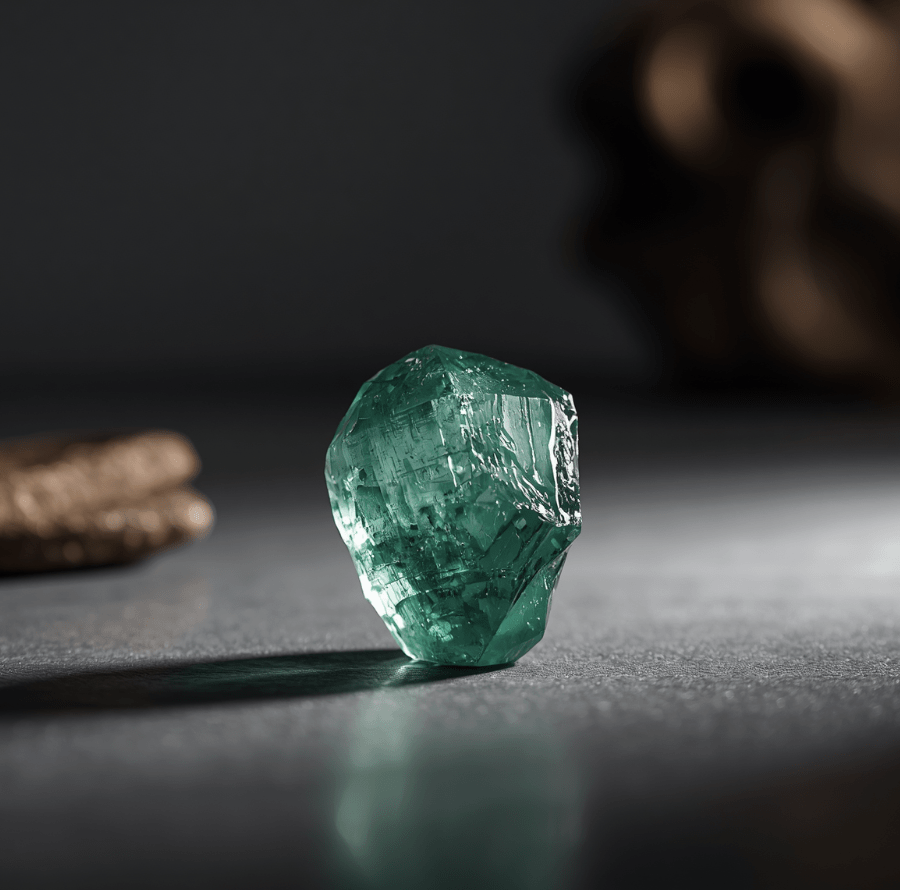
Green Aventurine is a variety of quartz composed primarily of silicon dioxide (SiO₂), distinguished by the presence of microscopic inclusions of fuchsite, a chromium-rich mica. These tiny reflective mineral platelets produce a subtle sparkling optical phenomenon known as aventurescence, giving the stone its characteristic depth and gentle shimmer.
Unlike transparent crystalline quartz, Green Aventurine is generally translucent, allowing light to diffuse softly while interacting with the reflective inclusions dispersed throughout the material.
With a Mohs hardness of approximately 6.5–7, Green Aventurine combines durability with remarkable visual complexity, making it a valued ornamental and lapidary stone for thousands of years.
Its quiet interplay between translucency and reflected light gives the material a living quality that changes gently as illumination and viewing angle shift.
Historical & Cultural Context
Green Aventurine has long been appreciated across many cultures as a material associated with renewal, prosperity, vitality, and harmonious growth.
Historically it has appeared in jewellery, carvings, decorative objects, and ceremonial artefacts throughout Asia, Europe, and the Middle East, admired for both its rich green colour and its subtle mineral sparkle.
Its natural resemblance to flourishing vegetation, spring growth, and healthy landscapes has consistently connected Green Aventurine with themes of opportunity, adaptability, and balanced development.
Across artistic and cultural traditions it has become a quiet symbol of resilience—growth achieved not through force, but through favourable conditions and steady progression.
Metaphysical Traditions
Within contemporary metaphysical traditions, Green Aventurine is frequently associated with optimism, emotional balance, personal growth, compassion, and new opportunities.
Many practitioners regard it as a material supporting resilience, adaptability, harmonious relationships, and the confidence to embrace positive change.
These interpretations arise from longstanding symbolic and cultural traditions rather than established scientific evidence and are best understood as meaningful frameworks through which many individuals choose to engage with the material.
Green Aventurine Within the Visual Resonance Method
Within the Visual Resonance Method, Green Aventurine most commonly fulfils the roles of Integrator and Harmoniser.
Its gentle aventurescent sparkle contributes visual continuity, renewal, and quiet vitality throughout a composition.
Rather than becoming a dominant focal point, Green Aventurine encourages balanced interaction between neighbouring materials, allowing individual characteristics to coexist while strengthening the coherence of the whole.
Within this framework, growth is understood not as continual expansion, but as the natural outcome of healthy relationships.
When every element is well supported, development becomes an emergent property rather than a forced objective.
Featured Within
Green Aventurine appears throughout the SNRGY.art collection in works exploring:
- Integration & Balance
- Abundance & Expansion
- Grounding & Stability
It is frequently paired with Rose Quartz to cultivate compassionate relationships, Moonstone to support reflective awareness, and Clear Quartz to strengthen coherence throughout the composition.
Material Relationships
Green Aventurine commonly appears alongside:
Rose Quartz – encouraging compassion, openness, and harmonious connection.
Moonstone – contributing rhythm, reflection, and adaptive awareness.
Clear Quartz – strengthening clarity and coherent relationships throughout the composition.
Together these materials establish compositions exploring balanced growth, emotional resilience, renewal, and meaningful integration.
Reflection
The healthiest ecosystems rarely grow through urgency.
They grow through relationship.
Through balance.
Through countless interactions that quietly support one another over time.
Green Aventurine reminds us that meaningful growth is rarely something we force.
It emerges when the conditions are right.
Within the Visual Resonance Method, Green Aventurine represents this living principle—a quiet expression of renewal, resilience, and the flourishing that naturally follows when every part of a system is able to contribute to the whole.
| Material Profile | |
|---|---|
| Material Function | Integrator · Harmoniser |
| Optical Behaviour | Aventurescence |
| Lustre | Vitreous |
| Crystal System | Trigonal (Quartz) |
| Composition | Silicon Dioxide (SiO₂) with Fuchsite Mica Inclusions |
| Mohs Hardness | 6.5–7 |
| Colour Harmonics | HRT |
| Common Segments | Integration & Balance · Abundance & Expansion · Grounding & Stability |
| Associated Archetypes | The Healer · The Cultivator |
| Often Paired With | Rose Quartz · Moonstone · Clear Quartz |
Working in Relationship
Integrators & Harmonisers rarely become the dominant voice within a composition.
Instead, they strengthen the relationships between surrounding materials, allowing amplifiers to reinforce clarity, grounding materials to establish stability, activators to encourage purposeful movement, and conductors to support continuity throughout the whole.
Their contribution is not to remove contrast, but to ensure that difference becomes complementary rather than conflicting.
Within the Visual Resonance Method, harmony emerges not through perfection, but through thoughtful relationship.
Featured Throughout the Collection
Integrators & Harmonisers appear throughout Scalar Discs, Studio Monotypes, and Primary Works where themes of connection, balance, compassion, renewal, and relational coherence are central to the work.
They are particularly associated with artworks exploring:
• Integration & Balance
• Abundance & Expansion
• Clarity & Insight
while also contributing gentle continuity and visual cohesion throughout layered compositions.
Explore Related Artworks →
Related Material Functions
Integrators & Harmonisers work in continual dialogue with the other Material Function Groups.
Amplifiers
Strengthening coherence and reinforcing relationships throughout a composition.
Regulators & Clarifiers
Supporting organisation, discernment, and balanced perception.
Grounding & Stability
Providing resilient foundations and structural integrity.
Activators & Motivators
Encouraging purposeful movement and creative emergence.
Conductors & Translators
Supporting continuity and communication between every element within a composition.
Reflection
Harmony is rarely created by making everything the same.
It emerges when each part is able to express its own character while remaining connected to something greater than itself.
Within the Visual Resonance Method, integration is understood as the quiet work of relationship.
Like the living systems found throughout nature, resilient compositions are built not through uniformity, but through diversity held together by thoughtful structure, mutual support, and balanced interaction.
The most enduring harmony is not imposed.
It is cultivated.

