
Organising Perception Through Discernment
“Clarity rarely comes from adding more information. It often emerges through organisation, rhythm, and thoughtful balance.”
Material Function
Regulators & Clarifiers contribute balance, organisation, and discernment within the Visual Resonance Method.
Rather than increasing intensity, these materials help organise relationships within a composition. They support visual clarity by introducing rhythm, perspective, and thoughtful structure, allowing the individual elements of a work to communicate with greater coherence.
Within the Material Language, regulation is understood as the practice of creating balance, while clarification concerns the emergence of insight through thoughtful organisation.
Like adjusting the focus of a lens or allowing still water to settle, these materials encourage perception through refinement rather than addition.
Regulation Within the Visual Resonance Method
Every composition within the Visual Resonance Method brings together geometry, colour, materials, light, and symbolic language.
Regulating materials contribute to the dialogue by supporting balance between these elements.
Rather than directing attention towards themselves, they help establish relationships that allow the composition to unfold more naturally.
Clarifying materials serve a complementary role, encouraging visual distinction and thoughtful perception.
Together they create space for observation.
Not by introducing more information, but by allowing existing information to become more apparent.
Materials Within This Function Group
Amethyst
A Variety of Quartz (Silicon Dioxide – SiO₂)
Material Function: Regulator · Clarifier
Geological & Scientific Context
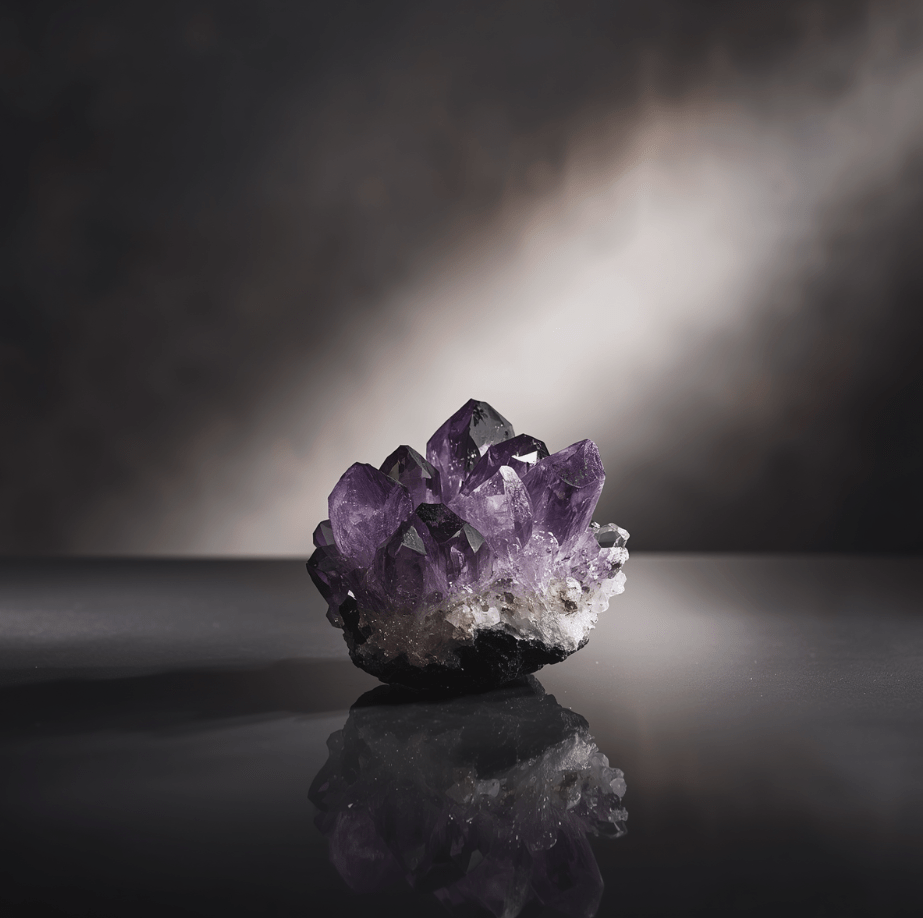
Amethyst is a violet variety of quartz composed primarily of silicon dioxide (SiO₂). Its distinctive colour develops through trace amounts of iron within the crystal lattice, combined with natural irradiation and the geological conditions present during its formation.
Like all quartz varieties, Amethyst crystallises within the hexagonal crystal system and exhibits piezoelectric properties, generating a small electrical potential when subjected to mechanical pressure. These measurable characteristics have contributed to quartz becoming one of the most extensively studied and technologically significant minerals in the natural world.
Amethyst commonly forms within volcanic geodes, where mineral-rich fluids slowly deposit successive layers of crystal over millions of years. This gradual process produces the striking crystalline structures that have fascinated both scientists and artists for centuries.
Historical & Cultural Context
Amethyst has been treasured throughout human history as a material associated with wisdom, clarity, and thoughtful judgement.
Its name derives from the ancient Greek word amethystos, meaning “not intoxicated.” Greek and Roman cultures believed the stone could protect against drunkenness and promote clear thinking, leading to its widespread use in drinking vessels, jewellery, and ceremonial objects.
During the Middle Ages, Amethyst became closely associated with contemplation, humility, and spiritual reflection. It frequently appeared within religious artefacts, royal regalia, and scholarly traditions, where its deep violet colour symbolised dignity, wisdom, and restraint.
Across many cultures, Amethyst has remained a symbol of measured perception, balance, and reflective awareness.
Metaphysical Traditions
Within contemporary metaphysical traditions, Amethyst is frequently associated with clarity, inner reflection, emotional balance, intuition, and expanded awareness.
It is often regarded as a material that supports calm observation, thoughtful decision-making, and the quieting of mental distraction.
These interpretations arise from longstanding cultural and spiritual traditions rather than established scientific evidence. Within the Visual Resonance Method they are recognised as part of the rich symbolic history surrounding the material, while remaining distinct from scientific understanding.
Amethyst Within the Visual Resonance Method
Within the Visual Resonance Method, Amethyst most commonly fulfils the roles of Regulator and Clarifier.
Rather than increasing intensity, it contributes organisation, perspective, and compositional balance.
Its cool violet harmonics naturally complement works exploring observation, discernment, and the gradual emergence of understanding.
Amethyst frequently appears where a composition benefits from visual stillness, allowing colour, geometry, and neighbouring materials to establish clear relationships without competing for attention.
Within this framework, regulation is understood as the thoughtful organisation of complexity, while clarification allows meaningful patterns to emerge through careful observation.
Featured Within
Amethyst appears throughout the SNRGY.art collection in works exploring:
- Clarity & Insight
- Integration & Balance
- Shadow Work & Transformation
It is frequently paired with Clear Quartz to strengthen coherence, Lapis Lazuli to deepen reflective qualities, and Moonstone where rhythm, transition, and gentle observation are central to the composition.
Material Relationships
Amethyst commonly appears alongside:
Clear Quartz – supporting clarity and coherence throughout the composition.
Lapis Lazuli – encouraging insight, communication, and deeper perception.
Moonstone – introducing rhythm, subtle transition, and reflective balance.
Together these materials contribute compositions exploring thoughtful observation, emotional equilibrium, and the gradual unfolding of understanding.
Reflection
The formation of an Amethyst crystal is measured not in days or years, but in geological time.
Its quiet growth within the earth reminds us that clarity rarely arrives all at once.
More often, understanding develops gradually—through observation, patience, and a willingness to look again.
Within the Visual Resonance Method, Amethyst represents this quiet process of refinement.
Not the pursuit of certainty, but the cultivation of perspective.
It reminds us that some of the clearest insights emerge not from striving harder, but from creating the conditions in which understanding is free to appear.
| Material Profile | |
|---|---|
| Material Function | Regulator · Clarifier |
| Optical Behaviour | Transparency |
| Lustre | Vitreous (Glass-like) |
| Crystal System | Hexagonal |
| Composition | Silicon Dioxide (SiO₂) |
| Mohs Hardness | 7 |
| Colour Harmonics | VIS · CLR |
| Common Segments | Clarity & Insight · Integration & Balance · Shadow Work & Transformation |
| Associated Archetypes | The Sage · The Healer · The Alchemist |
| Often Paired With | Clear Quartz · Lapis Lazuli · Moonstone · Selenite |
Lapis Lazuli
A Metamorphic Rock Composed Primarily of Lazurite
Material Function: Regulator · Clarifier
Geological & Scientific Context
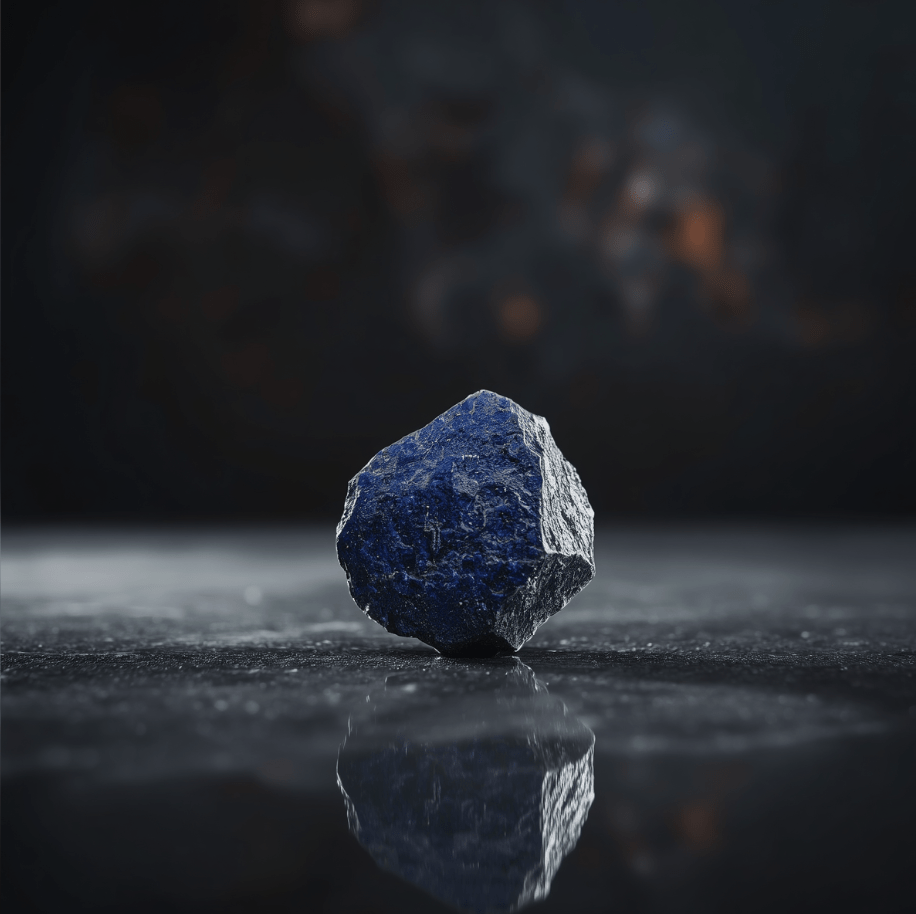
Lapis Lazuli is not a single mineral but a naturally occurring metamorphic rock composed primarily of lazurite, together with varying amounts of calcite, pyrite, sodalite, and other associated minerals.
Its remarkable ultramarine blue colour is produced by lazurite, while golden flecks of pyrite and white veins of calcite contribute to the distinctive appearance that has made Lapis Lazuli one of the most recognisable ornamental stones throughout human history.
The finest historical deposits originate from the Badakhshan region of present-day Afghanistan, where Lapis Lazuli has been mined continuously for more than 6,000 years, making it one of humanity’s oldest traded decorative materials.
Its complex mineral composition offers a striking example of how diverse geological elements can combine to form a coherent and unified whole.
Historical & Cultural Context
Few natural materials have held greater cultural significance than Lapis Lazuli.
Ancient Egyptian civilisation prized it as a symbol of wisdom, truth, and divine connection, incorporating it into jewellery, ceremonial objects, amulets, and the funerary treasures of pharaohs, including the famous mask of Tutankhamun.
Across Mesopotamia, Persia, Greece, Rome, India, and later Renaissance Europe, Lapis Lazuli became associated with learning, philosophy, nobility, and artistic excellence.
During the Renaissance, finely ground Lapis Lazuli was transformed into ultramarine pigment, one of the most precious and expensive artists’ pigments ever produced. Its rarity meant it was often reserved for the most significant commissions, becoming closely associated with sacred paintings and works of exceptional importance.
Its enduring legacy reflects humanity’s long relationship with knowledge, beauty, craftsmanship, and contemplation.
Metaphysical Traditions
Within contemporary metaphysical traditions, Lapis Lazuli is frequently associated with insight, wisdom, honest communication, self-expression, and expanded awareness.
Many traditions regard it as a material that encourages thoughtful dialogue, intellectual curiosity, and the integration of knowledge with lived experience.
These interpretations arise from longstanding symbolic and spiritual traditions rather than established scientific evidence and are best understood as meaningful cultural perspectives through which many individuals choose to engage with the material.
Lapis Lazuli Within the Visual Resonance Method
Within the Visual Resonance Method, Lapis Lazuli most commonly fulfils the roles of Regulator and Clarifier.
Its rich visual depth and naturally complex composition contribute qualities of organisation, perception, and thoughtful communication within a composition.
Rather than amplifying intensity, Lapis Lazuli encourages clarity through understanding.
Its layered mineral structure mirrors the way meaningful insight often emerges through the integration of multiple perspectives rather than a single idea.
Within this framework, Lapis Lazuli supports compositions exploring reflection, discernment, communication, and the patient organisation of knowledge into understanding.
Featured Within
Lapis Lazuli appears throughout the SNRGY.art collection in works exploring:
- Clarity & Insight
- Integration & Balance
- Expression & Communication
It is frequently paired with Amethyst to encourage reflective observation, Clear Quartz to strengthen compositional coherence, and Moonstone where thoughtful transition and balanced perception are central themes.
Material Relationships
Lapis Lazuli commonly appears alongside:
Amethyst – supporting reflection, discernment, and organised perception.
Clear Quartz – contributing clarity and coherence throughout the composition.
Moonstone – introducing rhythm, adaptability, and subtle transition.
Together these materials contribute compositions exploring thoughtful communication, balanced understanding, and the gradual unfolding of insight.
Reflection
For thousands of years, Lapis Lazuli has travelled across continents, carried by artists, scholars, merchants, and craftspeople who recognised something extraordinary within its deep blue surface.
Its beauty lies not in perfect uniformity, but in the harmonious relationship between many different minerals, each contributing its own character to the whole.
Within the Visual Resonance Method, Lapis Lazuli becomes a reminder that understanding is rarely formed from a single idea.
Like the stone itself, clarity often emerges when diverse perspectives find harmony within a larger composition.
| Material Profile | |
|---|---|
| Material Function | Regulator · Clarifier |
| Optical Behaviour | Opaque with Mineral Inclusions |
| Lustre | Vitreous to Greasy |
| Crystal System | Metamorphic Rock (Primarily Lazurite) |
| Composition | Lazurite, Calcite, Pyrite, Sodalite & Associated Minerals |
| Mohs Hardness | 5–5.5 |
| Colour Harmonics | VIS · EXP |
| Common Segments | Clarity & Insight · Integration & Balance |
| Associated Archetypes | The Sage · The Healer |
| Often Paired With | Amethyst · Clear Quartz · Moonstone · Selenite |
Lepidolite
A Lithium-Rich Mica Mineral
Material Function: Regulator · Clarifier

Geological & Scientific Context
Lepidolite is a lithium-bearing mica mineral belonging to the phyllosilicate group. Composed primarily of potassium, lithium, aluminium, and silicate, it develops in thin layered sheets that can be separated into delicate, flexible flakes—a defining characteristic of the mica family.
Its colours range from soft lilac and lavender through rose, violet, and pale grey, with a naturally pearlescent lustre that reflects light in subtle and shifting ways.
Lepidolite is one of the world’s most significant naturally occurring sources of lithium, an element now widely used in rechargeable batteries, ceramics, specialised glass, and numerous industrial technologies.
Its layered crystal structure and unique chemistry make Lepidolite both scientifically significant and visually distinctive.
Historical & Cultural Context
Compared with minerals such as Quartz or Lapis Lazuli, Lepidolite entered widespread awareness relatively recently.
First formally described during the eighteenth century, it became increasingly valued as mineralogy developed into a scientific discipline.
Collectors admired its delicate colours, shimmering surfaces, and unusual lithium-rich composition, while lapidary artists appreciated its quiet beauty despite its relative softness.
In contemporary crystal traditions, Lepidolite has become recognised for its association with transition, emotional balance, and gentle adaptation.
Its understated appearance has often made it a symbol of quiet strength rather than dramatic expression.
Metaphysical Traditions
Within many contemporary metaphysical traditions, Lepidolite is frequently associated with emotional balance, gentle regulation, acceptance, and periods of transition.
It is often regarded as a material that encourages calm reflection, adaptability, and the gradual release of unnecessary tension.
These interpretations arise from longstanding symbolic traditions rather than established scientific evidence and are best understood as meaningful cultural frameworks through which many individuals choose to engage with the material.
Lepidolite Within the Visual Resonance Method
Within the Visual Resonance Method, Lepidolite most commonly fulfils the roles of Regulator and Clarifier.
Its gentle colour harmonics and naturally layered structure contribute qualities of thoughtful adjustment, measured transition, and quiet organisation within a composition.
Rather than introducing dramatic contrast, Lepidolite encourages subtle refinement.
Its contribution is one of gentle regulation, allowing neighbouring materials, colours, and geometries to establish balanced relationships without unnecessary visual competition.
Within this framework, Lepidolite represents the quiet intelligence of adaptation.
The understanding that meaningful change often unfolds gradually through small adjustments rather than sudden transformation.
Featured Within
Lepidolite currently serves as part of the Material Language reference library and is not presently featured within the SNRGY.art collection.
Its inclusion reflects the evolving nature of the Visual Resonance Method and leaves space for future exploration as the material palette continues to develop.
Material Relationships
Lepidolite naturally complements materials including:
Amethyst – supporting reflection and thoughtful organisation.
Moonstone – encouraging rhythm, transition, and gentle adaptation.
Clear Quartz – contributing coherence and compositional balance.
Together these materials suggest compositions centred on reflection, adjustment, and the gradual emergence of clarity.
Reflection
Nature often reminds us that transformation is not always dramatic.
Sometimes the most meaningful changes occur quietly, layer by layer, almost unnoticed until we look back and recognise how much has evolved.
Within the Visual Resonance Method, Lepidolite represents this quieter rhythm of growth.
Not the force of change itself, but the wisdom of adapting with patience, grace, and thoughtful attention.
| Material Profile | |
|---|---|
| Material Function | Regulator · Clarifier |
| Optical Behaviour | Pearlescent Shimmer |
| Lustre | Pearly to Vitreous |
| Crystal System | Monoclinic |
| Composition | Potassium Lithium Aluminium Silicate |
| Mohs Hardness | 2.5–4 |
| Colour Harmonics | VIS · HRT |
| Common Segments | Integration & Balance · Clarity & Insight |
| Associated Archetypes | The Healer · The Sage |
| Often Paired With | Amethyst · Moonstone · Clear Quartz |
Moonstone
A Feldspar Mineral Exhibiting Adularescence
Material Function: Regulator · Clarifier
Geological & Scientific Context
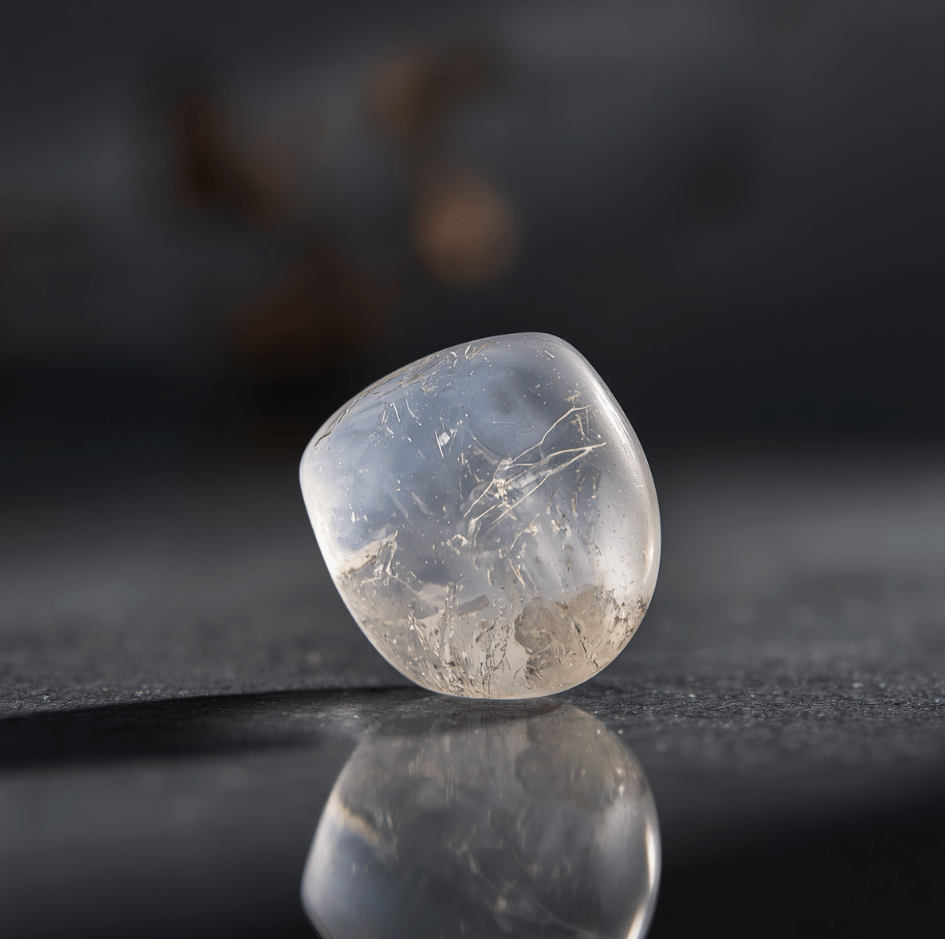
Moonstone is a member of the feldspar mineral group, composed primarily of orthoclase and albite. Its most distinctive characteristic is adularescence—a soft, floating glow that appears to move beneath the surface as the stone is viewed from different angles.
This remarkable optical effect is created through the interaction of light with microscopic alternating layers within the crystal, causing light to scatter and produce its characteristic luminous sheen.
Moonstone forms within igneous and metamorphic environments over long geological timescales. Although often associated with soft white or silvery tones, it also occurs in peach, grey, green, blue, and rainbow varieties, each displaying subtle variations in optical character.
Its changing appearance demonstrates how perception itself can be influenced simply by changing one’s perspective.
Historical & Cultural Context
Moonstone has been admired across cultures for thousands of years.
Ancient Roman scholars believed it contained captured moonlight, while many cultures throughout Asia regarded it as a symbol of intuition, harmony, and cyclical renewal.
In India, Moonstone has long been considered a sacred material associated with new beginnings and inner balance, frequently appearing in jewellery and ceremonial traditions.
During the Art Nouveau movement, artists and jewellers such as René Lalique celebrated Moonstone for its gentle luminosity, incorporating it into flowing organic designs inspired by nature, femininity, and transformation.
Throughout history, Moonstone has remained closely associated with rhythm, reflection, and the quiet beauty of continual change.
Metaphysical Traditions
Within contemporary metaphysical traditions, Moonstone is frequently associated with intuition, emotional balance, adaptability, and cyclical awareness.
Many traditions regard it as a material supporting reflection, patience, and the ability to navigate periods of transition with greater calm and understanding.
These interpretations arise from longstanding symbolic and cultural traditions rather than established scientific evidence and are best understood as meaningful frameworks through which many individuals choose to engage with the material.
Moonstone Within the Visual Resonance Method
Within the Visual Resonance Method, Moonstone most commonly fulfils the roles of Regulator and Clarifier.
Its softly shifting optical qualities contribute rhythm, subtlety, and gentle organisation within a composition.
Rather than creating immediate visual emphasis, Moonstone encourages slower observation.
Its appearance changes with movement, lighting, and viewing angle, reminding us that perception is not fixed but continually evolving.
Within this framework, Moonstone supports compositions exploring balance, transition, reflection, and the quiet emergence of understanding through changing perspective.
Featured Within
Moonstone appears throughout the SNRGY.art collection in works exploring:
- Integration & Balance
- Clarity & Insight
- Abundance & Expansion
It is frequently paired with Rose Quartz to support harmonious relationships, Green Aventurine to encourage balanced growth, and Clear Quartz to strengthen compositional coherence.
Material Relationships
Moonstone commonly appears alongside:
Rose Quartz – supporting compassion and harmonious connection.
Green Aventurine – encouraging steady growth and balanced opportunity.
Clear Quartz – contributing clarity and coherence throughout the composition.
Together these materials create compositions exploring integration, gentle transformation, emotional balance, and evolving awareness.
Reflection
Moonstone reveals one of nature’s quiet lessons.
The stone itself remains unchanged.
Only the light and our perspective move.
Yet with every shift, a different aspect becomes visible.
Within the Visual Resonance Method, Moonstone represents this relationship between perception and understanding.
Sometimes nothing around us has changed.
Only the way we have learned to see it.
| Material Profile | |
|---|---|
| Material Function | Regulator · Clarifier |
| Optical Behaviour | Adularescence |
| Lustre | Pearly to Vitreous |
| Crystal System | Monoclinic (Feldspar Group) |
| Composition | Potassium Sodium Aluminium Silicate |
| Mohs Hardness | 6–6.5 |
| Colour Harmonics | CLR · HRT · VIS |
| Common Segments | Integration & Balance · Clarity & Insight · Abundance & Expansion |
| Associated Archetypes | The Healer · The Sage · The Cultivator |
| Often Paired With | Rose Quartz · Green Aventurine · Clear Quartz · Amethyst |
Working in Relationship
Regulating and clarifying materials rarely operate in isolation.
They frequently work alongside amplifiers, grounding materials, harmonisers, activators, and conductors, contributing perspective while allowing neighbouring materials to retain their own distinct roles.
Their purpose is not to dominate the composition, but to help establish equilibrium between its many parts.
Featured Throughout the Collection
Regulators & Clarifiers appear across Scalar Discs, Studio Monotypes, and Primary Works where thoughtful observation, balance, and perception are central themes.
They are particularly associated with artworks exploring:
• Clarity & Insight
• Integration & Balance
• Shadow Work & Transformation
while also supporting works where discernment, reflection, and measured organisation contribute to the overall character of the composition.
Explore Related Artworks →
Related Material Functions
Regulators & Clarifiers work in continual dialogue with the other Material Function Groups.
Amplifiers
Strengthening coherence and reinforcing relationships throughout a composition.
Grounding & Shielding
Providing stability, containment, and resilient foundations.
Activators & Motivators
Encouraging momentum, confidence, and purposeful action.
Integrators & Harmonisers
Cultivating connection, emotional balance, and cooperative relationships.
Conductors & Translators
Supporting continuity and interaction between materials within layered compositions.
Reflection
Clarity is rarely created through accumulation.
More often, it emerges when unnecessary complexity falls away and meaningful relationships become easier to perceive.
Within the Visual Resonance Method, regulation and clarification are therefore understood as quiet acts of organisation.
They remind us that understanding is not always found by looking harder.
Sometimes it appears when we simply learn to see more clearly.

