Geometry Family
RAD— Radial Geometry
Secondary AXS • POR
Overview
The Sri Yantra is one of the most intricate geometric studies explored within the SNRGY.art practice. Composed of nine interlocking triangles arranged around a central point, it creates a highly ordered system of nested relationships that has been studied for centuries within mathematics, philosophy, architecture and traditional Indian sacred art.
Within the Harmonic Codex, the Sri Yantra is explored as a geometry of convergence. Rather than emphasising outward expansion or continuous circulation, it organises multiple structural relationships toward a shared centre, creating a visual language of integration, focus and coherent organisation.
It frequently appears where artworks investigate hierarchy, intentional composition and the relationship between complexity and unity.
Historical Context
The Sri Yantra, also known as the Shri Chakra, is one of the most complex and revered geometric diagrams within the Sri Vidya tradition of Hindu Tantra. In its traditional form, it is composed of nine interlocking triangles arranged around a central point, or bindu. Four of these triangles point upward and are commonly associated with Shiva, while five point downward and are associated with Shakti. Together, their intersections form forty-three smaller triangles arranged in concentric layers, creating a highly ordered diagram of union, manifestation and cosmic structure.
Traditional Sri Yantra diagrams usually include more than the central triangular structure. They are commonly surrounded by lotus-petal rings and an outer square enclosure known as the bhupura, often understood as a temple-like boundary with four gates. These outer elements frame the inner geometry and give the yantra its full ritual, devotional and cosmological architecture.
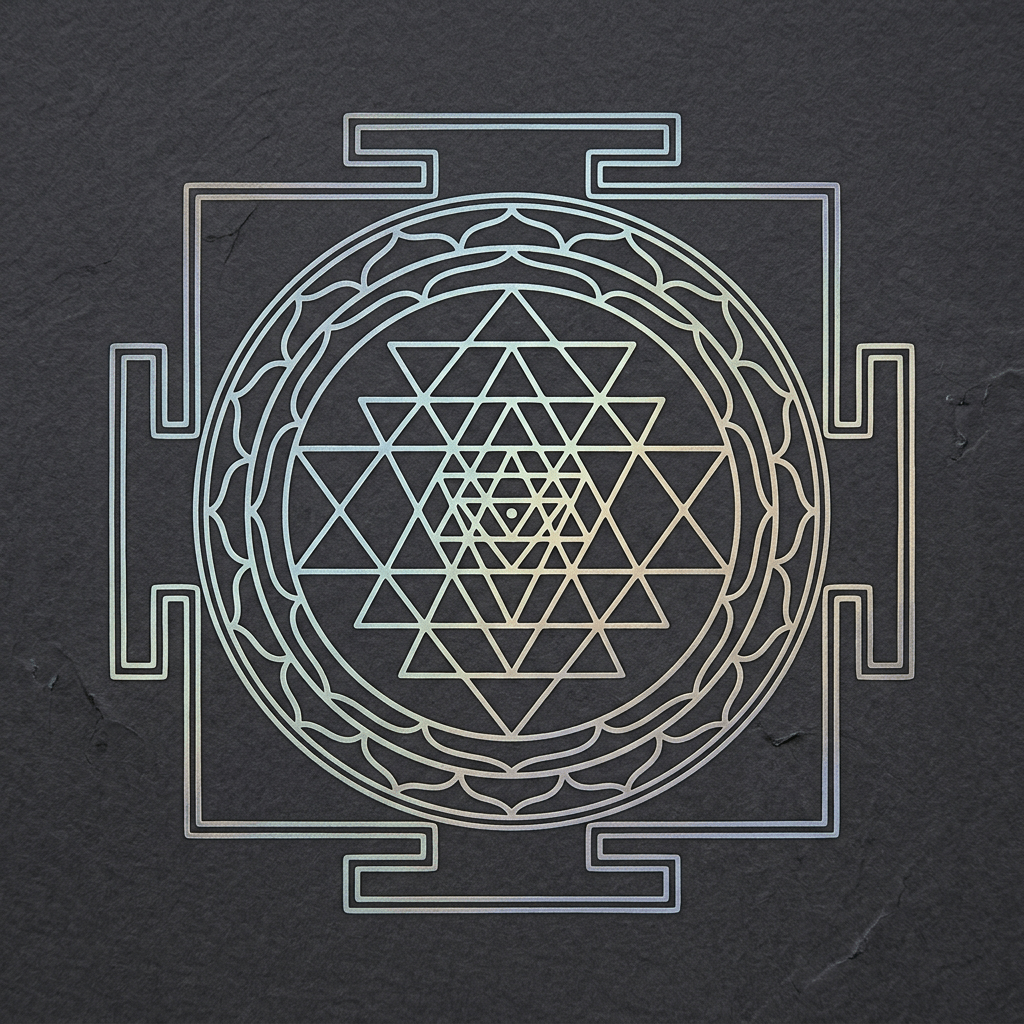
The variation used within the SNRGY.art Harmonic Codex intentionally focuses on the core triangular field of the Sri Yantra. This version preserves the interlocking upward and downward triangle system and its centralising structure, while omitting the surrounding lotus petals, outer square, gates and decorative boundary patterning.
Within the SNRGY.art practice, this refinement allows the geometry to be studied primarily as a system of convergence, proportional relationship and centred complexity. The emphasis is placed on the triangular architecture itself: the way multiple directional forces intersect, nest and resolve around a shared centre.
This adaptation is not presented as a replacement for the traditional Sri Yantra. Rather, it is a contemporary geometric variation used within the Harmonic Codex to explore the structural behaviour of the form within an artistic and archival context.
Within the SNRGY.art Practice
The Sri Yantra frequently appears where artworks investigate:
• convergence
• centred intention
• integrated complexity
• hierarchy
• intentional structure
• unified organisation
Within the Visual Resonance Method it provides a structural framework for compositions that organise multiple layers into a coherent centre, encouraging visual relationships that remain balanced despite their complexity.
Its significance always emerges through its relationship with the complete artwork.
Visual Characteristics
The Sri Yantra is formed through the precise intersection of nine triangles radiating around a common centre.
Unlike geometries that primarily express movement or expansion, the Sri Yantra establishes a layered hierarchy in which every element contributes to an increasingly ordered central focus.
Within the SNRGY.art practice this characteristic frequently supports investigations into compositional coherence and structured intention.
Harmonic Relationships
Within the Harmonic Codex the Sri Yantra frequently appears alongside investigations into:
• focused attention
• intentional organisation
• convergence
• structural harmony
• integrated complexity
These observations describe recurring themes documented throughout the SNRGY.art practice rather than fixed properties of the geometry itself.
As the archive continues to evolve, these relationships may expand through ongoing observation and documentation.
Appears Within
The following works currently incorporate the Sri Yantra as part of their geometric framework.
• Sovereign Archetype
• (Additional archive records will continue to be documented here.)
Related Geometry
The Sri Yantra naturally connects with several recurring geometric studies documented throughout the Harmonic Codex.
Continue exploring:
• Merkabah
• Cuboctahedron
• Seed of Life
• Fibonacci Spiral
Related Libraries
Continue exploring the wider relationships associated with this geometry.
Materials
Clear Quartz
Pyrite
Copper
Segments
Confidence & Courage
Clarity & Insight
Methodology
Visual Resonance Method
Studio Journal
Follow ongoing observations documenting how the Sri Yantra continues to evolve throughout the SNRGY.art practice.
Archive Notes
The Geometry Library documents the evolving role each geometric structure plays throughout the SNRGY.art practice.
Entries continue to expand as new artworks, observations and relationships are added to the Harmonic Codex, preserving both recognised geometric understanding and the continuing evolution of the creative practice.

