
The Physical Vocabulary of the Visual Resonance Method
Every crystalline material carries its own presence.
Some reflect light. Some absorb it. Some introduce texture, contrast, transparency, or weight. Others contribute geological history, symbolic meaning, or distinctive structural qualities that influence the character of a work.
Within the Visual Resonance Method, materials are selected not simply for what they are, but for the relationships they create when brought together.
Just as geometry provides structure and colour establishes atmosphere, material selection contributes another layer to the evolving language of each composition.
Rather than viewing individual materials in isolation, the Material Language framework considers the role each one plays within the broader harmony of the work.
Material as Relationship
Throughout both nature and art, meaning often emerges through relationship rather than individuality.
A single note becomes music only when heard alongside others.
A single colour becomes expressive through contrast.
A single geometric form gains significance through composition.
The same principle applies to materials.
Within the Visual Resonance Method, crystalline materials, metals, pigments, and layered resin construction are brought together to form integrated compositions where no single element defines the whole.
Instead, every material contributes to an emerging visual dialogue.
Observation Before Assumption
Crystalline materials have inspired centuries of scientific investigation, cultural symbolism, artistic practice, and personal reflection.
The Visual Resonance Method acknowledges this rich history while remaining grounded in observation.
The Material Language framework does not seek to define the intrinsic properties of any crystal or material. Instead, it describes the functional roles they play within the compositions developed through the Visual Resonance Method.
These roles have emerged through years of studio experimentation, observation, artistic practice, and continual refinement.
Rather than asking,
“What does this crystal do?”
the framework asks,
“What role does this material contribute within the composition?”
It is this shift—from individual properties to relational function—that forms the foundation of the Material Language.
Material Function Groups
Every crystalline material within the SNRGY.art collection contributes to one or more functional groups.
These categories provide a simple way to understand how different materials participate within the broader visual language of the Visual Resonance Method.
Each group forms another chapter within the evolving Material Language.
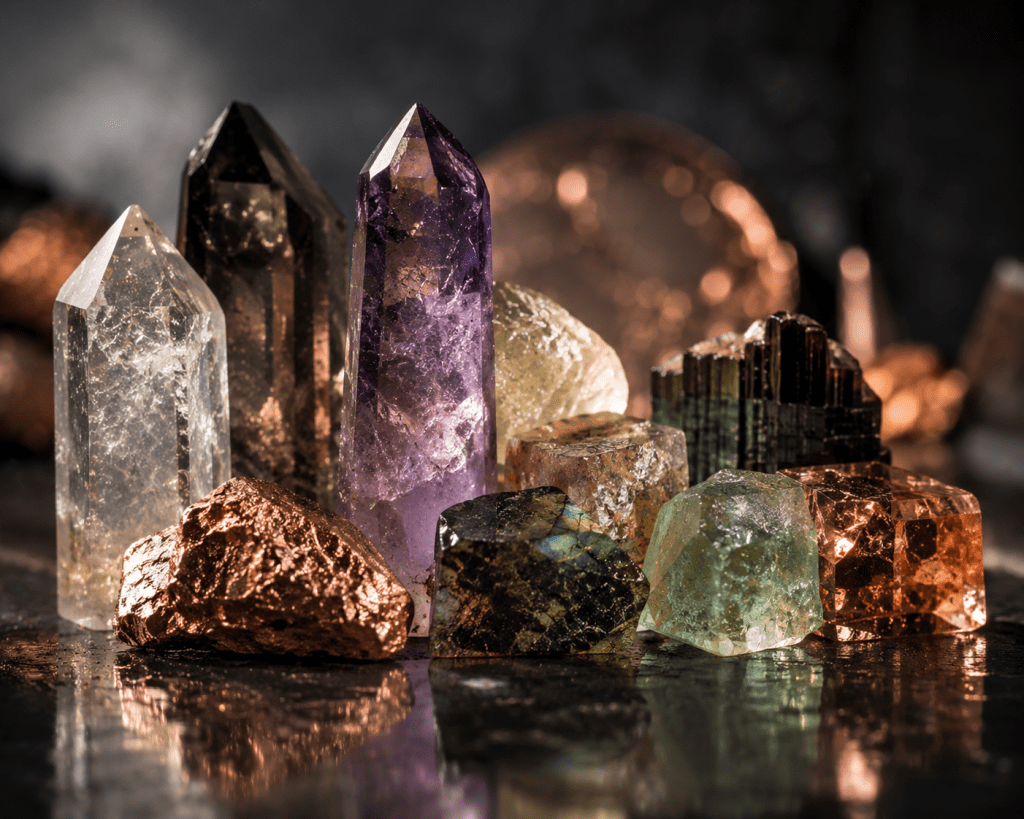
Amplifiers
Supporting clarity, coherence, and the strengthening of visual relationships within a composition.
Materials commonly associated with this group include:
• Clear Quartz
• Citrine
• Pyrite
Regulators & Clarifiers
Supporting organisation, reflection, discernment, and balanced visual structure.
Materials commonly associated with this group include:
• Amethyst
• Lapis Lazuli
• Lepidolite
• Moonstone
Explore Regulators & Clarifiers →
Grounding & Shielding
Contributing qualities of stability, resilience, containment, and structural integrity.
Materials commonly associated with this group include:
• Shungite
• Black Tourmaline
• Hematite
Explore Grounding & Shielding →
Activators & Motivators
Encouraging movement, momentum, confidence, and purposeful expression.
Materials commonly associated with this group include:
• Carnelian
• Tiger’s Eye
• Garnet
Explore Activators & Motivators →
Integrators & Harmonisers
Supporting connection, cooperation, emotional balance, and harmonious relationships throughout a composition.
Materials commonly associated with this group include:
• Rose Quartz
• Green Aventurine
Explore Integrators & Harmonisers →
Conductors & Translators
Supporting continuity, interaction, and the relationship between different materials within layered compositions.
Materials commonly associated with this group include:
• Selenite
• Angel Sand
• Clear Quartz
Explore Conductors & Translators →
A Living Material Library
The Material Language continues to evolve alongside the Visual Resonance Method.
As new materials are explored, relationships observed, and artworks created, the framework grows through direct studio practice rather than fixed definitions.
Every addition expands the vocabulary.
Every artwork becomes another opportunity to observe how materials interact with colour, geometry, light, and one another.
The Material Language is therefore not a finished catalogue, but a living reference—an evolving record of the physical vocabulary through which the Visual Resonance Method continues to develop.
Whether encountered within a Scalar Disc, a Studio Monotype, or a Primary Work, every material contributes its own voice to the larger conversation.
Together, they form a language that is still being written.
Material Profile
Every material within the Visual Resonance Method possesses measurable physical characteristics that contribute to its unique visual identity. Alongside its geological composition and crystal structure, qualities such as transparency, lustre, optical phenomena, and hardness influence the way a material interacts with light, space, and surrounding elements.
The Material Profile brings these observations together in a concise reference, combining established mineralogical information with the functional role each material fulfils within the Visual Resonance Method. Rather than defining a material by a single attribute, the profile illustrates how its physical characteristics, visual behaviour, and artistic application combine to inform its place within the broader Material Language.
| Material | Optical Characteristic |
|---|---|
| Clear Quartz | Transparency |
| Citrine | Transparency |
| Amethyst | Transparency |
| Moonstone | Adularescence |
| Tiger’s Eye | Chatoyancy |
| Green Aventurine | Aventurescence |
| Labradorite (future) | Labradorescence |
| Opal (future) | Opalescence |
| Pyrite | Metallic Reflectivity |
| Lapis Lazuli | Opaque Mineral Composition |
| Shungite | Opaque Carbon Structure |
| Selenite | Fibrous Translucency (Satin Spar varieties) |

